The short version
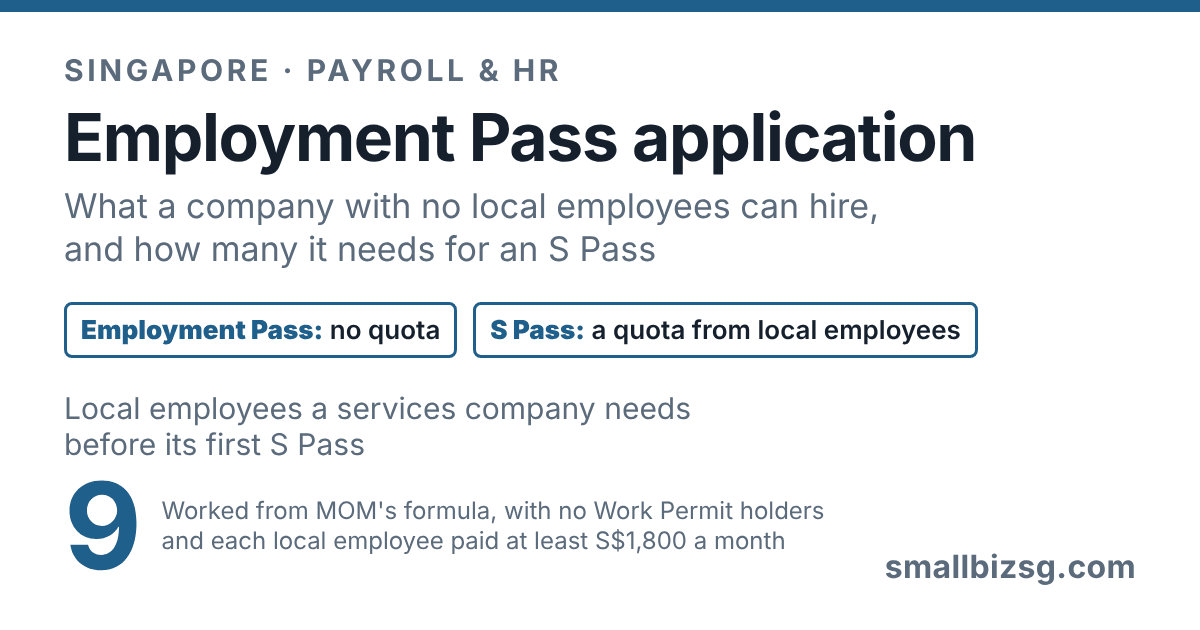
Of the three work passes for hiring foreign staff, a company with no local employees can get only one: the Employment Pass, the pass for professionals, managers and executives. Local employees are the Singapore citizens and permanent residents a company employs.
The Ministry of Manpower (MOM), the ministry that issues the passes, checks two things in an Employment Pass application. The fixed monthly salary, without bonuses, must reach MOM’s minimum for the candidate’s age: for applications from 1 January 2027, S$6,000 a month at 23 or below, rising to S$11,500 at 45 or above. And the application must score 40 points in COMPASS, MOM’s points system, 20 of which a company with fewer than 25 professionals gets automatically.
Before applying, check that each local employee, you included if you’re a citizen or permanent resident on a salary, gets at least S$1,800 a month before deductions if full-time, or S$10.50 an hour if part-time, more in some jobs. The company must make sure local employees in administrative or driving roles are trained within six months of being hired, in one of two ways MOM accepts; it can apply only while it meets these rules. Set up EP eService, MOM’s online service for applying; check the candidate in MOM’s Self-Assessment Tool; and get their written consent and verification proof of their degree: a copy of the certificate doesn’t count. After MOM approves, the candidate comes to Singapore, you have the pass issued, and only then may they start work.
- Who each pass is for, and which one a company without local employees can get
- Why an S Pass needs nine local employees first
- MOM’s minimum salary for an Employment Pass
- The points system: how a small company reaches 40 points
- The job advertisement, and when a company under 10 employees can skip it
- Who applies, and the steps from application to first day
- What an Employment Pass holder costs the company
- Who is punished if the rules are broken
Who each pass is for, and which one a company without local employees can get
Only the Employment Pass needs no local employees, so it’s the one of the three a company without them can apply for. The other two are the S Pass, the pass for skilled workers, and the Work Permit, the pass for semi-skilled workers. A foreigner may work in Singapore only on a valid work pass, the general name for all three.
| Pass | Who it’s for | Lowest salary, applications from 1 January 2027 | Local employees needed first |
|---|---|---|---|
| Employment Pass | Managers, executives and professionals with a job offer in Singapore | S$6,000 a month at 23 or below, more with age | None |
| S Pass | Skilled workers who may not meet the Employment Pass’s criteria: MOM calls them associate professionals and technicians | S$3,600 a month at 23 or below, more with age | Nine, in the services sector |
| Work Permit | Semi-skilled workers from approved countries and regions, in the construction, manufacturing, marine shipyard, process or services sector | No minimum | Some, not worked out in this post |
Needing local employees first means needing a quota: a number of places for S Pass and Work Permit holders, which MOM works out from the company’s local employees, as the next section explains. The company also pays MOM a levy, a monthly charge, for each S Pass or Work Permit holder: S$650 a month for an S Pass. An Employment Pass needs no quota and carries no levy to MOM, only the small training levy of the section on costs.
This post’s example company is invented, and so are its dates and salaries; the rules are MOM’s. It’s a consultancy outside financial services with one owner, its only director, who is paid a director’s fee and no salary, which matters for the count of local employees below. It has one employee: a Singapore citizen it pays S$3,600 a month from 1 December 2026, as in the post on hiring a first employee. A company with no local employees at all applies for an Employment Pass the same way. On 4 January 2027 the example applies for one for a consultant aged 30, whose degree MOM accepts though it isn’t from a university on MOM’s top-tier list; the points system says where to find the list.
Why an S Pass needs nine local employees first
In the services sector, a company with no S Pass or Work Permit holders needs nine local employees before it can apply for its first S Pass. The nine comes from MOM’s quota, the number of S Pass holders a company may employ: MOM’s guide to the quota adds one to the company’s workforce, for the candidate it wants to hire, takes 10% of the total, and rounds it down. The workforce is the company’s local employees plus its S Pass and Work Permit holders; Employment Pass holders aren’t counted.
The table runs MOM’s formula and shows where the first place appears.
| Local employees | Plus the candidate | 10% of that | S Pass places, rounded down |
|---|---|---|---|
| 0 | 1 | 0.1 | 0 |
| 1, the example | 2 | 0.2 | 0 |
| 8 | 9 | 0.9 | 0 |
| 9 | 10 | 1 | 1 |
So the example has no S Pass places, even if MOM counts its owner. The table is this post’s own arithmetic, by MOM’s formula.
A company can apply only while it has a place left over, which MOM calls a quota balance, and MOM gives no places in advance for staff it plans to hire.
For the quota, MOM counts local employees from the salaries and Central Provident Fund (CPF) contributions the company declares for them. CPF is Singapore’s national savings scheme, which a company pays into for each citizen or permanent resident it employs. One paid at least S$1,800 a month gross counts as one, one paid S$900 to below S$1,800 as half, and one paid less not at all; the pay rule in the next section still applies. MOM averages the count over the latest three months, and a new employee starts to count once the company pays their first full month’s salary and CPF.
The owner counts too if they’re a citizen or permanent resident employed under a contract of service, an employment contract written or not, as an owner on a salary is. MOM’s page doesn’t say how it counts a director paid only a fee, like the example’s owner.
The construction, manufacturing, marine shipyard and process sectors take 15% instead of 10%, and MOM’s quota calculator works out a company’s own figures.
MOM’s minimum salary for an Employment Pass
From 1 January 2027, MOM’s minimum is S$6,000 a month for a candidate aged 23 or below, and it rises with age to S$11,500 at 45 or above. For applications before then it runs from S$5,600 to S$10,700.
What counts is the fixed monthly salary: basic pay plus fixed monthly allowances, without bonuses, commission or overtime.
| Candidate’s age | Minimum a month, applications before 1 January 2027 | Minimum a month, from 1 January 2027 |
|---|---|---|
| 23 or below | S$5,600 | S$6,000 |
| 25 | S$6,064 | S$6,500 |
| 30, the example’s candidate | S$7,223 | S$7,750 |
| 35 | S$8,382 | S$9,000 |
| 40 | S$9,541 | S$10,250 |
| 45 or above | S$10,700 | S$11,500 |
MOM’s eligibility page gives the figure for every age between. A company in financial services, insurance included, needs more: from 1 January 2027, S$6,600 a month at 23 or below, rising to S$12,700 at 45 or above.
A second pay rule concerns the company’s local employees, not the candidate. MOM’s rule covers companies that employ foreigners, Employment Pass holders included. Each full-time local employee, working 35 to 44 hours a week, must get at least S$1,800 a month gross, before their own CPF, and each part-timer at least S$10.50 an hour gross. Some jobs need more: MOM’s progressive wages, a higher minimum for each level of a job, cover administrative roles, such as clerks, receptionists and secretaries, and driving roles in any company that employs foreigners, and jobs in sectors such as cleaning and security.
The company must also make sure local employees in these administrative and driving roles are trained within six months of being hired. Any one completed course of the Workforce Skills Qualifications system, Singapore’s national system for training and certifying work skills, counts, and so does an in-house programme with set objectives, method, tasks and length, and records of who attended. A company can apply for new work passes, or renew them, only while it meets these rules. So before you apply, check these rules for each local employee, you too if you’re a citizen or permanent resident on a salary. The example’s citizen employee, at S$3,600, is above S$1,800 and above S$3,340, the highest administrative progressive wage until 30 June 2027, so the salary clears every administrative level.
The points system: how a small company reaches 40 points
A company with fewer than 25 professionals gets 20 of the 40 points automatically, so the candidate’s salary and qualifications, or bonus points, must bring the other 20. With a top-tier degree, worth 20, MOM’s minimum salary is enough. With another degree MOM accepts, or a professional qualification on its list, worth 10, the salary must earn 10 too: at 30 in professional services, S$8,283 a month for applications from 1 January 2027. With none of them, it must earn 20: S$14,316. MOM scores applications this way, in COMPASS, its points system, when it assesses them. Once EP eService is set up, you or an agency acting for the company can check the likely score, the qualification’s points included, in MOM’s Self-Assessment Tool, so check there before you set the salary; MOM’s own score may differ.
| Criterion | What MOM compares | A company with fewer than 25 professionals scores |
|---|---|---|
| Salary | The candidate’s fixed monthly salary, against local professionals’ pay in the company’s sector at the same age | 0, 10 or 20 |
| Qualifications | The candidate’s degree or professional qualification | 20 from an institution on MOM’s top-tier list; 10 from another degree MOM accepts, or a professional qualification on MOM’s list; 0 otherwise |
| Diversity | How many of the company’s professionals share the candidate’s nationality | 10, automatically |
| Support for local employment | The company’s share of local professionals, against other companies in its sector | 10, automatically |
MOM names the institutions whose degrees earn 20 points, Singapore’s autonomous universities among them, and the professional qualifications that earn 10, in two lists it updates once a year. Another degree earns 10 if MOM judges it comparable to a UK bachelor’s degree. To claim a qualification’s points, you send verification proof with the application, from a source MOM accepts: a background screening company on MOM’s list, the university’s or a government’s verification portal, or OpenCerts, for some schools’ digital certificates. A copy of the certificate doesn’t count, and MOM doesn’t ask again for a qualification it has verified. The screening companies’ websites give their fees.
MOM publishes the salaries that earn points for each sector and age, once a year. Use your company’s own sector: MOM sets it from the main business activity the company declared to the Accounting and Corporate Regulatory Authority (ACRA), the company registrar, and shows it in myMOM Portal, MOM’s site for a company’s work passes. The table gives the figures for professional services, the example’s sector, for applications from 1 January 2027.
| Candidate’s age | Fixed monthly salary for 10 points | Fixed monthly salary for 20 points |
|---|---|---|
| 23 or below | S$6,500 | S$9,693 |
| 30, the example’s candidate | S$8,283 | S$14,316 |
| 35 | S$9,556 | S$17,618 |
| 45 or above | S$12,102 | S$24,223 |
At every age shown, the 10-point salary is above MOM’s minimum: at 30, S$8,283 against S$7,750. A salary below the 10-point figure scores 0, and other sectors’ figures are in MOM’s table. For applications made in 2026, MOM’s current table applies instead: at 30 in professional services, S$8,010 for 10 points and S$13,772 for 20.
The example company first thinks of offering S$8,000, above MOM’s minimum of S$7,750. The table shows why that fails, and why it offers S$8,500, a round figure above S$8,283.
| The example’s application | Offering S$8,000 | Offering S$8,500 |
|---|---|---|
| Salary: 10 points from S$8,283 | 0 | 10 |
| Qualifications: a degree, not top-tier | 10 | 10 |
| Diversity: fewer than 25 professionals | 10 | 10 |
| Support for local employment: fewer than 25 professionals | 10 | 10 |
| Total, with 40 to pass | 30, fails | 40, passes |
At S$8,000 the candidate passes MOM’s first check, the minimum salary, but scores only 30 points. At S$8,500 the example scores 10 on each criterion and passes with 40, like MOM’s own case of a small company. The example supposes MOM accepts the candidate’s degree; if it didn’t, the degree would score 0, and only a salary of S$14,316 or more would pass.
Bonus points can add up to 20 for a job on MOM’s Shortage Occupation List, and 10 for some programmes run with the government’s economic agencies (MOM’s eligibility page). A candidate paid at least S$22,500 a month needn’t pass COMPASS, nor one transferring from the company’s office overseas or filling a role of a month or less.
The job advertisement, and when a company under 10 employees can skip it
A company with fewer than 10 employees needn’t advertise the job before it applies. Most other companies must first advertise the job on MyCareersFuture, the jobs website MOM’s rule names, for at least 14 days in a row, and make no job offer in those 14 days. Advertising elsewhere too is allowed, and MOM’s page sets what the advertisement must show, such as the salary range.
The example, with one employee, or two if its owner counts, is under 10 either way, so it needn’t advertise; MOM’s pages don’t say whether an owner counts.
Without the advertisement, MOM still expects a small company to consider Singaporeans fairly. If Singaporeans apply, judge them on what the job needs, as you judge the foreign candidate, and never on characteristics unrelated to the job, such as age, sex, nationality or race. MOM investigates complaints of discriminatory hiring, and a company it finds discriminating can be barred from new work passes and renewals for at least 12 months, up to 24.
Who applies, and the steps from application to first day
In a one-person company, you apply yourself, online in MOM’s EP eService, if you’re a Singapore citizen or permanent resident, or hold an EntrePass (MOM’s pass for entrepreneurs), Employment Pass or S Pass under the company. A citizen or permanent resident employee may apply for the company too. Otherwise there are two routes:
- someone at an outside firm, such as an HR consultancy, an accounting firm or your secretarial firm, uses the company’s EP eService once you, as the company’s director, have submitted MOM’s online authorisation form for them;
- an employment agency licensed by MOM applies itself, as the company’s appointed agent; MOM’s EA Directory lists the licensed ones.
Before its first application, the company sets up EP eService through Corppass, the government’s system through which a company lets people use government online services in its name:
- The company’s Corppass administrator (the post on a company’s secretary explains who that is) gives the person who will register access to WPAR, MOM’s registration service.
- In WPAR, that person registers the company and names its EP eService administrator, preferably the owner, a director or a senior employee. MOM deals with it, or gives an update, within a week.
- The Corppass administrator gives each person who will apply access to EP eService and myMOM Portal, where the EP eService administrator adds them as users.
In a one-person company, the owner can be both the person who registers and the EP eService administrator, if they’re a citizen or permanent resident, or hold an EntrePass, Employment Pass or S Pass under the company.
The steps for each application, from MOM’s page on applying:
- You check the candidate with MOM’s Self-Assessment Tool, which needs an EP eService account. If it says not eligible, the application will be rejected; if eligible, MOM puts the chance of a pass at around 90%.
- You get the candidate’s written consent: any document showing they agree to be employed by the company, such as a signed employment contract; spoken consent doesn’t count. Then you collect the details the application asks for on MOM’s candidate’s form, which you can send the candidate to fill in, and order early any verification proof the degree needs: most checks take up to 14 working days.
- You apply and pay S$105. The application needs documents such as the candidate’s passport page and, if it needs the qualification’s points, the verification proof. The candidate needn’t be in Singapore. MOM processes the application, or gives an update, within 10 business days.
- MOM approves in principle, its yes before the pass itself. You print the approval letter in EP eService and send the candidate their copy, which lets them enter Singapore. You must have the pass issued within six months of the approval; if the candidate can’t come by then, ask in EP eService to extend it. Bring the candidate in only after this approval: MOM can’t extend the visit pass, a visitor’s permission to stay, of a candidate who arrives earlier.
- You have the pass issued and pay S$225 in EP eService, once the candidate is in Singapore. MOM issues the pass at once. If MOM’s notification letter says so, the employee registers fingerprints and a photo at MOM within two weeks.
- The employee starts work once the pass is issued: MOM’s notification letter, sent when it issues the pass, lets them. Not before: employing a foreigner without a valid work pass is an offence.
Figure 1 shows these steps for the example company. MOM’s answer, or an update, is due by 18 January 2027, 10 business days after it applies; MOM’s approval and the consultant’s arrival then set the first day.
The example company’s first Employment Pass, step by step
Its date is invented; MOM decides when an application is approved.
- Before applying The company’s step It checks the candidate with MOM’s Self-Assessment Tool and gets their written consent
- 4 January 2027 Invented date It applies in EP eService and pays S$105, for a salary of S$8,500 a month
- Within 10 business days MOM’s time MOM’s answer, or an update
- Approval in principle MOM’s yes, before the pass The candidate may now enter Singapore
- Within six months of it With the candidate here The company pays S$225, and MOM issues the pass at once
- Once the pass is issued Not before The employee starts work: employing a foreigner without a valid work pass is an offence
Rules from MOM’s pages and the Employment of Foreign Manpower Act 1990, linked in the text. Read on 26 October 2026.
A first pass lasts up to two years and a renewal up to three. The company can renew it from six months before it expires, for S$225 again, and the renewal must pass COMPASS too, on the salary figures MOM sets for passes expiring then.
What an Employment Pass holder costs the company
For a new Employment Pass, the company pays MOM S$330 in fees: S$105 to apply and S$225 to issue it. Each month it pays the employee’s salary and, as the table shows, at most S$11.25 of training levy. Foreigners don’t take part in CPF, so there’s no CPF, and there’s no levy to MOM.
| What | Amount | Paid by the company to |
|---|---|---|
| Fee to apply | S$105, for a new pass | MOM |
| Fee to issue the pass | S$225, for a new pass and at each renewal | MOM |
| Salary | At least MOM’s minimum for the candidate’s age, and enough to pass COMPASS | The employee |
| Skills Development Levy | 0.25% of the month’s pay: at least S$2, at most S$11.25 | The board that runs CPF, with the CPF; or the government’s skills agency directly, if every employee is foreign |
The Skills Development Levy is a compulsory levy for training, paid for every employee working in Singapore, foreigners included, at the rates in the table. The company adds up the amounts, rounds the total down to the dollar, and pays it with its CPF to CPF Board, the board that runs CPF, which collects it for the Skills and Workforce Development Agency. A company whose employees are all foreign pays the agency directly.
No insurance is compulsory for an Employment Pass holder doing office work. Medical insurance is the company’s choice. Work injury compensation insurance, the insurance that pays an employee’s claim for an injury at work, is compulsory only for manual work, or for employees paid S$2,600 a month or less. Without it, the company still pays a valid claim itself: medical leave wages, medical expenses, and compensation for permanent incapacity or death.
The company can’t take its costs from the employee, from their pay or any other way: costs such as the pass fees, any medical examination MOM requires and any training the company requires are the company’s. So is sending the employee home when the job ends, unless they have signed a document that explicitly agrees to pay for it.
The table gives the example’s month once its Employment Pass holder has started.
| What the company pays in a full month with both employees | Amount | Paid to |
|---|---|---|
| The citizen employee’s salary | S$3,600 | The employee, S$2,880; CPF Board, S$720, the employee’s own CPF share taken from the salary |
| The company’s CPF for the citizen employee, 17% of the salary | S$612 | CPF Board |
| The Employment Pass holder’s salary | S$8,500 | The Employment Pass holder, all of it, with no CPF taken |
| Skills Development Levy: S$9 for the citizen employee (0.25% of S$3,600), plus S$11.25 for the Employment Pass holder (the most), S$20.25 rounded down | S$20 | CPF Board, with the CPF |
| The company’s total for its two employees that month | S$12,732 | The two employees and CPF Board |
S$12,732 (S$3,600 + S$612 + S$8,500 + S$20) is what the company pays for its two employees that month, not what anyone takes home; it leaves out the owner’s fee and the one-off pass fees. The citizen employee’s figures come from the post on hiring a first employee. The new hire adds S$8,511 a month: the S$8,500 salary and S$11 more of levy (S$20 − S$9). A company whose only employee is its Employment Pass holder pays the same S$8,511: the S$8,500 salary to the employee, and S$11 of levy (S$11.25 rounded down), which it pays directly to the Skills and Workforce Development Agency.
Who is punished if the rules are broken
The company is punished as the employer, and its director can be too. Under section 20 of the Employment of Foreign Manpower Act, a company’s offence is also its officers’ (a director, manager, secretary or similar) if they agreed to it or knowingly let it happen, or if it came from their neglect. The company and the officer can then each be convicted and punished. If the officer mainly responsible didn’t supervise reasonably, the Act treats the offence as their neglect unless they prove otherwise. In a one-person company that officer is the owner, so supervise whoever acts for the company, and check in EP eService what an agent or a secretary submits in its name.
- Employing a foreigner without a valid work pass: a fine of S$5,000 to S$30,000, up to 12 months’ jail, or both, for each person convicted in court, the company or its officer, on a first conviction.
- Giving MOM information that’s false or misleading: a fine of up to S$20,000, up to two years’ jail, or both, for any person who gives it knowing, or when they ought reasonably to know, that it’s false.
- Taking the company’s costs from the employee: a financial penalty of up to S$20,000, which MOM itself imposes on the employer.
- Counting people it doesn’t employ: paying CPF for local people who don’t work for it, to raise its S Pass or Work Permit quota, brings a penalty of up to S$20,000 for every work pass application made with the inflated quota, and a bar on hiring foreign workers.
Where these facts came from
The pages below were read on 26 October 2026, and the Acts and regulations are cited as they stood that day. The pages’ own dates run from 28 July 2021 to 22 October 2026; MOM’s COMPASS tables and lists print their release month instead.
| What | Pages |
|---|---|
| Which pass is for whom, who applies, which need a quota and a levy, and the S$650 levy; a valid work pass | MOM: Employment Pass key facts (4 May 2026); S Pass (18 September 2026) and its key facts (4 March 2026); Work Permit key facts (1 July 2026); S Pass levy and quota requirements (19 February 2026); Employment of Foreign Manpower Act 1990, section 5 |
| The quota: 10% of the workforce plus one in services, 15% in the other four sectors, rounded down; the workforce without Employment Pass holders; a quota balance and no quota in advance; the three-month average and a new company’s first month; the calculator | MOM: guide to computing the quota (PDF, updated 1 July 2026), S Pass levy and quota requirements, the FAQs on advance quota (1 July 2026), the total workforce (14 March 2024) and new companies (14 March 2024); quota calculator (14 March 2024) |
| Counting local employees: one at S$1,800 a month or more, half at S$900 to below S$1,800, the director included under a contract of service, from the first full month’s salary and CPF; what CPF is; what a contract of service is | MOM: how to count local employees (1 July 2026), employers’ CPF contributions (24 October 2024); CPF Board: Who we are (3 March 2026); Employment Act 1968, section 2 |
| The Employment Pass salary: S$5,600 to S$10,700 before 1 January 2027 and S$6,000 to S$11,500 from it, by age: S$6,064 and S$6,500 at 25, S$7,223 and S$7,750 at 30, S$8,382 and S$9,000 at 35, S$9,541 and S$10,250 at 40; financial services S$6,600 to S$12,700, and which firms count; the top third; fixed monthly salary | MOM: Employment Pass eligibility (28 April 2026), which firms count as financial services (14 March 2024), what a fixed monthly salary is (14 March 2024); Employment of Foreign Manpower (Work Passes) Regulations 2012, Sixth Schedule |
| The pay rule for local employees: S$1,800 a month gross for 35 to 44 hours a week, S$10.50 an hour gross part-time, progressive wages for each level of a job for administrative and driving roles, and S$3,340 a month for an administrative supervisor from 1 July 2026 to 30 June 2027, the highest administrative figure; progressive wages in sectors such as cleaning and security; training in administrative and driving roles within six months of hiring, a Workforce Skills Qualifications course or an in-house programme, and what those qualifications are; no new or renewed passes for a company that doesn’t meet these rules; an owner on a salary counted as a local employee | MOM: Local Qualifying Salary (1 July 2026), Occupational Progressive Wages for administrators and drivers (12 October 2026), how to count local employees; Skills and Workforce Development Agency: Singapore Workforce Skills Qualifications (25 September 2026) |
| The S Pass salary from 1 January 2027 | MOM: S Pass key facts |
| COMPASS: 40 points, the four criteria, 10 points automatically on two of them with fewer than 25 professionals, the kinds of qualification that earn 20 and 10 and the yearly lists, verification proof from three kinds of source, OpenCerts among them, a copy of a certificate not accepted, one verification for each qualification, and the screening companies’ fees and checks of up to 14 working days; the bonus criteria, S$22,500 and the two other cases, the small company’s case | MOM: Employment Pass eligibility, the lists of institutions awarded 20 points and professional qualifications awarded 10 (PDFs, “Released in November 2025”), Documents required (18 May 2026) for the three kinds of verification proof, the requirements for a verification proof (16 July 2026) |
| The salaries that earn COMPASS points: S$6,500 to S$12,102 for 10 points and S$9,693 to S$24,223 for 20 in professional services, applications from 1 January 2027, with S$8,283 and S$14,316 at 30, and S$9,556 and S$17,618 at 35; S$8,010 and S$13,772 at 30 for applications in 2026; a salary below the 10-point figure scoring 0; the survey and yearly updates; how MOM sets a company’s sector, and checking it in myMOM Portal | MOM: COMPASS C1 salary benchmarks (11 August 2026), C1 salary benchmarks by sector for 2027 (PDF, “Released in Aug 2026”) and 2026 (PDF, “Released in Aug 2025”), checking a company’s sector (15 July 2026) |
| The Self-Assessment Tool: who may use it, an EP eService account, the likely COMPASS score, “not eligible”, about 90%, and a score that may differ from MOM’s | MOM: Employment / S Pass Self-Assessment Tool (7 May 2025) |
| The job advertisement: MyCareersFuture, 14 days in a row, no offer in them, what it shows; fewer than 10 employees; fair hiring, complaints, and a bar of 12 to 24 months | MOM: Employment Pass: consider all candidates fairly (5 January 2026), why small companies needn’t advertise (14 March 2024), Fair Consideration Framework (8 August 2025) |
| Applying: who may use EP eService, the authorisation form and who sends it, registering in WPAR and naming an administrator, Corppass and the myMOM Portal; a licensed employment agency appointed by the company, the EA Directory, and tracking an agency’s transactions; written consent and the candidate’s form, the documents, S$105 and 10 business days; approval in principle, printing its letter, six months, extending it, and the visit pass; S$225, fingerprints and a photo within two weeks, and the notification letter; up to two years and three; renewing from six months before expiry | MOM: EP eService (1 June 2026), Work Pass Account Registration (1 June 2026), myMOM Portal (18 August 2026), the authorisation form, licensed employment agencies (14 March 2024), written consent (14 March 2024), Apply for an Employment Pass (15 June 2026), Documents required, Renew an Employment Pass (17 August 2026), Employment Pass key facts; Corppass: About Corppass |
| The costs: no CPF for foreigners; the Skills Development Levy, 0.25%, S$2 to S$11.25, rounded down, paid with CPF or to the agency; insurance, work injury compensation insurance at S$2,600 a month or less, and a valid injury claim paid without it; the costs the company bears (the pass fees, medical examinations and insurance MOM requires, training the employer requires, and repatriation), and sending the employee home | MOM: the written answer on CPF for foreigners (28 July 2021), an Employment Pass holder’s medical care (14 March 2024), Work injury compensation insurance (11 July 2024), paying for sending a pass holder home (14 March 2024); CPF Board: Skills Development Levy (2 July 2026), How do I calculate and pay the SDL? (22 October 2026); Employment of Foreign Manpower Act 1990, section 25 |
| The example’s month: S$3,600, S$612 (17%), S$720 and S$2,880 for its citizen employee, from the post on hiring a first employee; S$9 and S$11.25 of levy, S$20 in all | The rows above, and CPF Board’s rates as the post on hiring a first employee applies them |
| Penalties: who answers for a company’s offence, each convicted and punished, and the presumption of neglect; S$5,000 to S$30,000 or 12 months; S$20,000 or two years; S$20,000 for taking the company’s costs; S$20,000 for every application made with an inflated quota, and the bar | Employment of Foreign Manpower Act 1990, sections 5, 20, 22 and 25; MOM: written answer on phantom workers (2 March 2026) |
| Tax clearance when a foreign employee leaves | Inland Revenue Authority of Singapore (IRAS): Tax Clearance for Foreign & SPR Employees (IR21) (4 March 2026) |
Rules and pages change. If something here has gone out of date, tell me and I’ll correct it and note when it was corrected.
What this post is not
I’m not a lawyer or an employment agent, and nothing here is advice about your situation.
This post leaves out the other passes on MOM’s Work passes page, such as those for trainees and family members. It also leaves out the steps for an S Pass or a Work Permit application, and how many local employees a first Work Permit needs. Nor does it cover the tax clearance an employer must seek from IRAS, the tax authority, when a foreign employee leaves the job.
It doesn’t cover a foreign founder applying for their own Employment Pass through their own company, or a domestic worker. The duties every employee brings, from written terms to payslips and leave, are in the post on hiring a first employee.
This post rests on published sources alone, and it was drafted with AI assistance and checked by me against them. No link here is an affiliate link, the kind where a seller pays the site a fee if a reader buys something through it.
Nobody paid for a mention, and the page on how this site is paid for says the rest.