The short version
If you’re the only director of your company, you can’t also be its company secretary, the person who helps keep the company’s records in order. The Companies Act is the law that sets the rules for a company secretary in Singapore. It says a sole director “must not act or be appointed as the secretary”.
- Who can. A real person whose main or only home is in Singapore, the Act says. The Accounting and Corporate Regulatory Authority (ACRA) is the government body that registers businesses. ACRA adds that the secretary must be a Singapore citizen, a permanent resident or someone who meets local residency rules (listed further down).
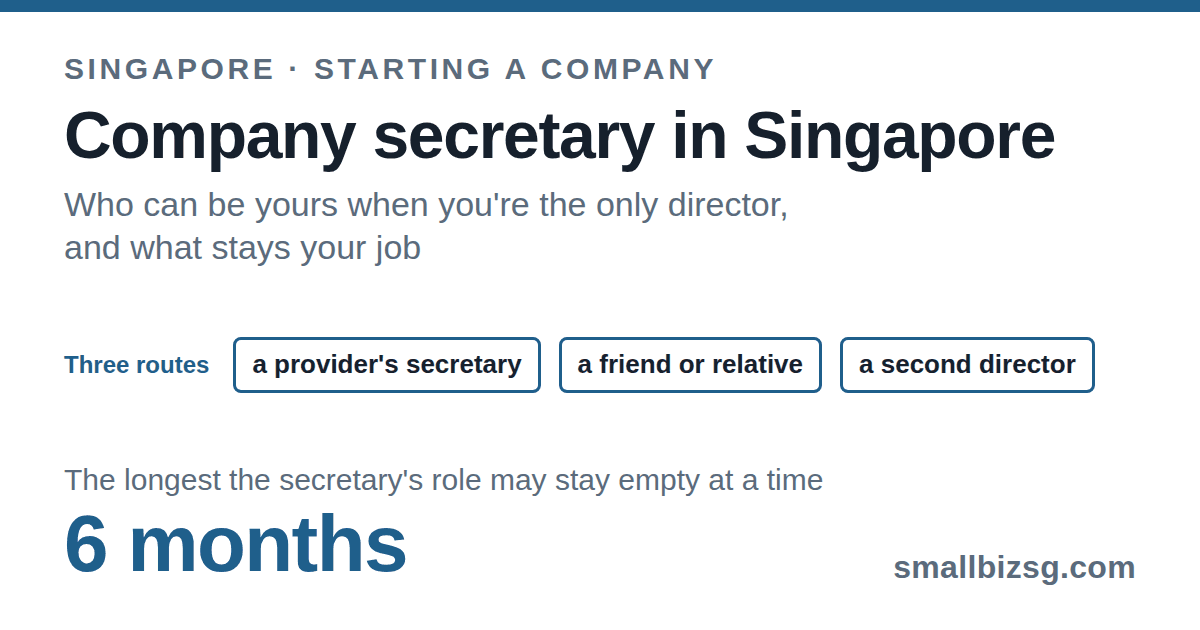
- By when. A new company has six months from registration to appoint one. From then on, the role can’t stay empty for more than six months at a time. Otherwise, the director may face a fine of up to S$1,000.
- Three routes. Someone arranged by a corporate service provider, a business registered with ACRA to offer company services. A friend or relative, though whether they’d have to register as a provider is an open question. Or a second director: once there are two, either may also be the secretary, since the rule applies only to a sole director.
- What stays yours. Your duties as a director, such as filing the annual return (the company’s yearly online form with ACRA) on time.
- Changing. You can change your secretary at any time. You must file the change within 14 days on Bizfile, the site where ACRA’s filing services are online. Appointing the new one before the old one leaves means the role is never empty. The steps are further down.
Every rule here is linked to the official page or law it comes from, all read on 20 October 2026. This is sourced information, not advice about your own company, drafted with AI assistance and checked by me.
- Who can be your company’s secretary, and why a sole director can’t
- The six-month limit, and what happens if you miss it
- Three ways to fill the role when you’re the only director
- What a company secretary does
- What stays your job after you appoint one
- How to check a provider is registered, and what to agree in writing
- Who holds your company’s Corppass
- How to change or replace your secretary
Who can be your company’s secretary, and why a sole director can’t
ACRA’s page on company officers sets three conditions. A company secretary must:
- “Be a real person (not a company)”
- “Be a Singapore citizen, Singapore permanent resident, or someone who meets local residency rules”
- “Not be the same person as the sole director”
ACRA’s eligibility page lists who meets the local residency rules. Besides citizens and permanent residents, they are holders of a valid Employment Pass, Personalised Employment Pass or Overseas Networks & Expertise Pass.
The same page has a step for holders of a Foreign Identification Number (FIN), the ID number of a foreigner with a long-term pass. They should check with the agency that issued their pass before accepting a role. An Employment Pass holder, for example, “must first seek a Letter of Consent” from the Ministry of Manpower.
ACRA’s guide to appointing officers adds that to appoint a foreigner, “you need to engage a corporate service provider”, that is, hire one. It doesn’t say who counts as a foreigner for this purpose. Anyone unsure can ask ACRA through its contact page, linked in the friend route below.
The Companies Act words the rule its own way, in section 171. The secretary must be “a natural person who has his or her principal or only place of residence in Singapore”. The person also must not be debarred, that is, barred by the Registrar of Companies from taking on secretary roles (section 155B).
Overall, the secretary must be a citizen, a permanent resident or one of the pass holders above, with their main or only home in Singapore.
The Act sets no fixed qualification for a private company’s secretary. Fixed requirements, such as membership of a professional body, apply to public companies’ secretaries (section 171(1AA)).
If a private company fails to keep a register or record the Act requires, the Registrar can step in. It can make the company appoint a secretary with the qualifications public companies need (section 171(1AB)).
Taking care to pick someone capable is still your duty. The Act says the directors must take “all reasonable steps” to make sure each secretary seems to them to have the knowledge and experience the role needs.
The rule that bars a sole director is section 171(1E): “Where a director is the sole director of a company, he or she must not act or be appointed as the secretary of the company.”
It applies only to a sole director. Once a company has two directors, either of them may also be its secretary, you included. ACRA’s pages don’t say this directly; it follows from section 171’s wording, which bars only a sole director.
One limit remains. Where the Act says something must be done by “a director and the secretary”, one person holding both roles can’t do it alone (section 171(5)).
The six-month limit, and what happens if you miss it
ACRA’s page on company officers gives the limit in two sentences: “A secretary must be appointed within six months of successful registration. The position cannot be empty for more than six months.”
The Act’s section 171(4A) puts it this way: “The office of secretary must not be left vacant for more than 6 months at any one time.” So the limit applies to every gap, not only the first.
The bar on a sole director, quoted above, applies to acting as the secretary as well as being appointed. So a sole director can’t act as the secretary, even for a short gap.
Take an example company, with invented dates: a one-person private limited company registered on 15 July 2024. It must appoint its first secretary by 15 January 2025. If that secretary left on 16 February 2026 and nobody replaced them, a new one would be due by 16 August 2026.
The company registration post’s first-year calendar puts the first of those dates beside the company’s other first-year deadlines.
If the role stays empty too long, ACRA says “the director may face a fine” of up to S$1,000.
Three ways to fill the role when you’re the only director
Whoever takes the role must meet the conditions above and give their consent when they’re appointed. The appointment is filed on Bizfile. The section on changing your secretary explains how; a company appointing its first secretary after registration uses the same steps.
| Route | Who it is | What the law asks | What you do |
|---|---|---|---|
| A provider’s secretary | Someone the provider arranges | The provider is registered with ACRA | Check its registration; agree the terms in writing |
| A resident person you know | A friend or relative | The conditions above (but see below) | Choose someone capable, as the Act requires |
| A second director | Either director, once there are two | The conditions above, plus the rules for directors | Appoint someone who’ll carry a director’s duties too |
A provider’s secretary. The Corporate Service Providers Act 2024 (CSP Act) took effect on 9 June 2025. Under it, “acting, or arranging for another person to act” as a company’s secretary is a corporate service. A section below shows how to check that a provider is registered.
This post quotes no provider prices: each provider sets its own, and only official fees appear here. What a provider does for a new company, and what it can’t, is in the company registration post.
A resident person you know. A friend or relative can take the role if they meet the conditions above and consent to act. A friend who holds a pass should seek consent from the agency that issued it before accepting. ACRA’s rule above on appointing a foreigner may also apply.
The difficulty is the CSP Act. ACRA’s page on who must register says anyone who provides any of the services it lists “to others” must register as a provider. Acting as a company’s secretary is one of them.
The Act’s own test, in section 7(1), is whether a person carries on “a business in Singapore of providing any corporate service” without being registered. Neither page says how this applies to a friend who does it unpaid for one company. If that’s your route, ask ACRA first, in writing, through the feedback and enquiry form on its contact page.
A second director. As explained above, either of two directors may also be the secretary. But a second director takes on a director’s duties, set out below, not just the secretary’s work. ACRA’s page on company officers lists the rules a director must meet, such as being at least 18 and not banned or disqualified.
What a company secretary does
ACRA sums the role up in one line: “Company secretaries help the company to comply with its requirements.” Its page on company officers lists their administrative work as including:
- keeping the company’s information and registers
- organising meetings and taking notes
- reminding directors about annual filing deadlines
- updating everyone on any new rules
The Companies Act adds a duty that secretaries share with directors: each must give the company their own details, such as their name and address. They must do it no later than 14 days after being appointed, and again within 14 days of any change to those details (section 173B).
The Act counts the secretary as an officer of the company (section 4(1)). Some of the Act’s offences fall on an officer “who is in default”, and so can reach the secretary as well as a director.
An officer in default is one who, knowingly and on purpose, commits one of those offences or authorises or permits it (section 408(3)).
What stays your job after you appoint one
A secretary helps the company comply but doesn’t take over your duties. ACRA’s page on company officers says a director can’t escape the duties by being an “inactive director” or a “sleeping director”. In its words, “All directors are responsible under the legislation, whether active or not.”
ACRA’s page on directors’ duties lists five duties that every director carries:
- keeping proper accounting records
- preparing financial statements, where the law requires them
- holding an annual general meeting, the yearly meeting of shareholders, where the law requires one
- filing annual returns
- keeping the company’s information and registers up to date
ACRA’s page on the annual return puts the filing duty in one sentence: “As a director, it is your legal duty to file on time.” From 20 October 2026, the annual return also asks the company to confirm that the details ACRA holds on its directors and secretaries are accurate. Before the company files the return, ACRA says to update on Bizfile any details that aren’t accurate.
The secretary reminds you of deadlines; meeting them stays your duty. What a late annual return costs is in the company registration post’s penalty section.
Some duties are shared. ACRA’s page on updating company information says “Directors and secretaries must report changes”, via Bizfile within 14 days.
How to check a provider is registered, and what to agree in writing
ACRA’s page on the CSP Act says that from 9 June 2025, “all corporate service providers (CSPs) must register with ACRA”. CSPs are what this post calls providers.
An unregistered provider faces a fine of up to S$50,000, up to two years in jail, or both (section 7(4)). If the offence continues after a court has convicted the provider, the same section adds a fine of up to S$2,500 for each day.
Those penalties are the provider’s own, but the check is yours. If your company already has a provider, start from the company’s record on Bizfile.
Logged in to Bizfile for my own company, I find its provider of record under ‘My Corporate Service Provider’. That’s the provider ACRA has on record for the company, and the name to check.
Then check that name, or that of any provider you’re considering. ACRA’s page on who must register gives a tip: “You can use Bizfile’s entity search to check whether an entity is a CSP.”
The entity search is Bizfile’s search for companies and other organisations. Search for the provider by name and open its profile from the results. ACRA’s guide to Bizfile’s searches adds: “If the entity is a CSP, you can view their CSP information at the bottom of their entity profile.”
Before you sign up, get the terms in writing, even if it’s only the provider’s reply to your email. Ask it to set out:
- who your secretary will be, by name
- which filings it makes for you, such as the annual return, and by when
- how much notice it gives if it stops acting, so the role isn’t left empty past six months
- whether it keeps your register of controllers, the company’s own list of who owns or controls it, at its office, as ACRA allows, and how you’d get it back if you leave
- what its yearly fee covers, and what costs extra
Who holds your company’s Corppass
Corppass is the system that controls who can act for your company on government digital services. It matters here because, when the company files a change itself, the Bizfile filing that appoints or withdraws a secretary starts with it. ACRA’s guide to appointing officers has the filer log in through Corppass as a “Business User”, the login for acting for a business.
The role that matters is the Registered Officer. It’s for people who “hold principal authority” in a company, such as a director (what a Registered Officer is).
For a local company, the kind this post is about, the Registered Officer has had to be a director since 17 March 2025. Before then, the role was open to a “Company Officer (e.g. Director or Company Secretary)” (Corppass’s definitions).
Corppass takes its list of officers from ACRA and works out who qualifies. So every director of a local company can act as its Registered Officer. In the example company, that’s its one director.
The Registered Officer approves or removes the company’s Corppass Admins (Corppass’s home page). An Admin creates the company’s Corppass accounts and gives each one access to the services it needs. A company can have “up to two Corppass Admins”, each holding a Singapore NRIC (National Registration Identity Card) or FIN (what an Admin is).
Within those limits, an Admin can be anyone the Registered Officer authorises, a company secretary included. To see who your Admins are, go to Services > Find Your Corppass Admin on the Corppass site.
If you’ve never used Corppass, you can be an Admin yourself. Go to Services > Register for Corppass on the Corppass site and log in with Singpass, the personal login for government services. A Registered Officer who applies is approved automatically (registering as an Admin).
A provider can instead be given Third Party Authorisation, which lets a company authorise its service providers to act for it on government digital services. You pick which services it covers and how long it lasts (how to authorise). Only services that allow it, and that the company has added to its list of services, can be picked.
Who holds the keys to your company’s Corppass
- Registered OfficerAny director, from 17 March 2025Approves or removes the company’s Corppass Admins, and can be oneBefore then: a company officer, such as a director or the secretary
- Corppass AdminUp to two, each with a Singapore NRIC or FINCreates the company’s Corppass accounts and gives each one access to the services it needsA Registered Officer who applies is approved automatically
- A providerCan be authorised by the company through Third Party AuthorisationActs for the company on the services you pick, for the period you set
From Corppass’s own pages, linked in the sources at the end. Checked on 20 October 2026.
When you change provider, remove the old one under Third Party > Manage Third Party Entities (Corppass on removing a third party). Its users then “will no longer be able to represent your entity” for what you removed. Check your Admins too, remove any you don’t want, and authorise the new provider for the services you’ve agreed in writing.
The Corppass answers linked here leave one thing open: what happens to an Admin that a secretary approved before 17 March 2025. Whatever the answer, you can see your Admins and remove any you don’t want.
How to change or replace your secretary
If you’re replacing a secretary, appoint the new one before the old one leaves. The Act allows a company “one or more secretaries”, so the role need never fall empty (section 171(1)). Otherwise the six-month limit starts the day the role falls empty.
You can change your secretary at any time, ACRA’s page on company officers says. You “must file these changes through Bizfile within 14 days of the change”, and that’s the company’s deadline.
ACRA’s guide to appointing and withdrawing officers lists the fee as “Free”. When the company files a change itself, the filing starts with the Corppass login above.
Appointing the new secretary. You or a provider files the appointment. If you file it, the new secretary endorses it: they log in to Bizfile with Singpass and confirm their consent. They have 14 days, or “the update may be rejected”.
No endorsement is needed when a provider files, or when the new secretary files their own appointment.
Removing the old one. ACRA’s guide says “Company officers cannot withdraw themselves”, so you or a provider files the withdrawal. The old secretary then usually endorses it the same way, unless a provider files it.
But if a secretary resigns and the company doesn’t tell ACRA, the secretary can tell ACRA themselves. They use a form ACRA calls a Notice of Cessation, a notice that the role has ended. It costs S$0.
Filing late. ACRA’s late filing penalty for a change of officers depends on how late the filing is. It’s S$50 within three months of the due date, or S$200 after that. Those amounts apply to due dates from 9 December 2024, and a late annual return has separate penalties.
In ACRA’s own example, a director leaving and a new one joining count as two changes. Filed more than three months late, they cost S$200 each, S$400 in all.
In court. Not reporting a change within the 14 days is an offence. The company and each officer in default, as defined above, can each be fined up to S$5,000 if a court convicts them (section 173H(1)). If the offence continues after a conviction, up to S$200 more can follow for each day (section 408(1)).
Finishing in Corppass. If you’ve changed provider, remove the old provider’s authorisation and check your Admins, as the section above explains.
Where these facts came from
Every page below was read on 20 October 2026, and the two Acts are quoted as they stood that day. The other pages’ own dates run from 21 December 2023 to 19 October 2026; Corppass’s home page shows none.
| What | Pages |
|---|---|
| Who may be a secretary: a real person, a citizen, permanent resident or someone who meets local residency rules, not the sole director; who meets those rules, and a pass holder’s check with the agency that issued the pass; a secretary within six months of registration, and the role never empty for more than six months; the director’s fine of up to S$1,000; what a secretary does; changing officers at any time, filed through Bizfile within 14 days; the rules for directors; all directors responsible, active or not | ACRA: Directors and key officers, Requirements and eligibility |
| ACRA, the government body that registers businesses; Bizfile, where ACRA’s filing services are online; a FIN, the ID number of a foreigner with a long-term pass | ACRA: Overview of ACRA, Contact us; Immigration & Checkpoints Authority (ICA) on AskGov: What a FIN is |
| The Companies Act on the secretary: one or more secretaries, each with a main or only home in Singapore and not debarred; debarment; the directors’ duty to pick someone capable; public companies’ qualifications, and the Registrar’s power; the sole-director bar; two people for a “director and the secretary” step; never vacant for more than six months; each officer’s own details within 14 days; the secretary as an officer, and an officer in default | Companies Act 1967: section 171, section 4, sections 172 to 173H, sections 155B, 407 and 408 |
| What stays the director’s: the five duties; the annual return, and filing it on time; from 20 October 2026, confirming in it that the details ACRA holds on directors and secretaries are accurate; the company’s registers; directors and secretaries report changes within 14 days | ACRA: Directors’ duties, Annual return deadlines, Company registers, Updating company information, Changes from 20 October 2026 |
| Providers: the CSP Act from 9 June 2025; acting as a secretary as a corporate service; registration, and who must register; a fine of up to S$50,000, up to two years in jail, and up to S$2,500 a day; checking a provider on Bizfile; asking ACRA | ACRA: Corporate Service Providers Act, Checking if you must register, Using Bizfile’s search functions, Contact us; CSP Act 2024: Part 1, section 7 |
| Corppass: the Registered Officer, a company officer until 16 March 2025 and a director from 17 March 2025, taken from ACRA’s records; principal authority; approving or removing Admins, and finding them; up to two Admins, NRIC or FIN holders, anyone the Registered Officer authorises; registering as an Admin, and automatic approval; Third Party Authorisation, its services, its period, and removing it | Corppass on AskGov: Registered Officer definitions, Key updates, What a Registered Officer is, Corppass Admin, The first Admin, Third Party Authorisation, How to authorise, Removing a third party; Corppass home page |
| Changing a secretary: the free filing and its Corppass login; endorsement within 14 days, and when none is needed; officers can’t withdraw themselves; a resignation the company doesn’t report, and the Notice of Cessation (a notice that the role has ended), S$0; a foreigner appointed through a provider, and a FIN holder’s consent; late filing penalties of S$50 within three months or S$200 after, for due dates from 9 December 2024, and a director leaving and one joining as two changes, S$200 each and S$400 in all, in ACRA’s example; a fine of up to S$5,000 each, and up to S$200 a day | ACRA: Appointing or withdrawing position holders, Reporting a resignation, Notice of cessation, Late lodgment penalties, Common offences; Companies Act 1967: sections 172 to 173H, sections 155B, 407 and 408 |
Rules and pages change. If something here has gone out of date, tell me and I’ll correct it and note when it was corrected.
What this post is not
I’m not a lawyer, an accountant or a corporate service provider, and nothing here is advice about your company’s situation. It sets out the rules on company secretaries as ACRA, Corppass and the two Acts state them.
It’s written for a private limited company with one director, and it quotes no providers’ prices. Public companies are left out: their secretaries need fixed qualifications under section 171(1AA). Setting up the register of controllers is in the company registration post’s first-year calendar.
This post was drafted with AI assistance and checked by me against the sources above. No link here is an affiliate link, the kind where a seller pays the site a fee if a reader buys something through it. Nobody paid for a mention, and the page on how this site is paid for says the rest.