The short version
A company must pay into Singapore’s Central Provident Fund (CPF) for each employee earning over S$50 a month who is a citizen or permanent resident. CPF is a national savings scheme: the money becomes the employee’s own CPF savings, for their retirement, housing and healthcare. A permanent resident is someone from another country who is allowed to live in Singapore permanently.
Each month the company pays two CPF contributions, the employer CPF contribution and the employee’s share. It pays both to CPF Board, the government body that collects them for the Central Provident Fund. For a citizen under 55, or one whose 55th birthday falls in the month worked, the two are:
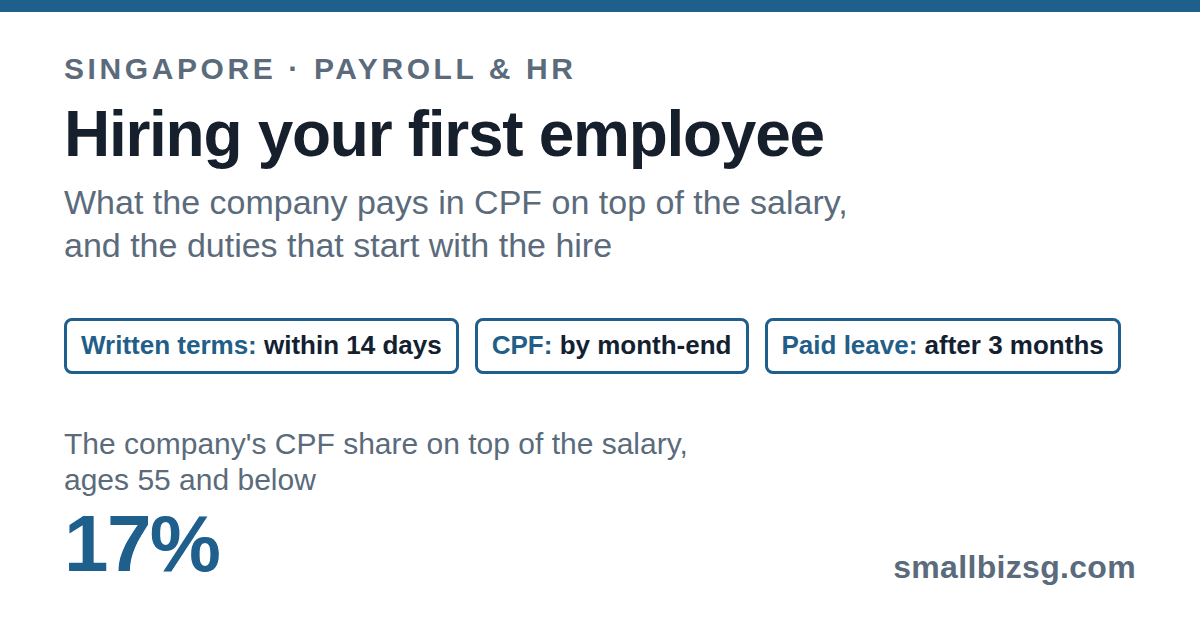
- The employer CPF contribution: the company’s own share, 17% of the month’s pay. The company pays it in addition to the salary.
- The employee’s share: 20% of the month’s pay, when the pay is S$750 a month or more. The company pays this to CPF Board too, but the law allows the company to deduct the amount from that month’s salary. When it does, the employee receives their salary minus their share.
The next section covers permanent residents, older employees, lower pay and high salaries. For another age or salary, CPF Board’s CPF contribution calculator calculates the contributions.
The company also pays the Skills Development Levy (SDL), a compulsory payment for every employee working in Singapore, whatever their nationality. It is 0.25% of the month’s pay, with a minimum and a maximum that the section after this summary gives. A company that pays CPF contributions pays the levy to CPF Board with them, and the money goes into a fund for training workers.
This post’s example company and its dates and amounts are invented; the rules, rates and their start dates are the government’s. It is a one-person private limited company set up on 15 July 2024, and its owner is its only director. Suppose it hires its first employee on 1 December 2026: a citizen aged 30, doing office work for S$3,600 a month.
So each month the company pays out S$4,221 in total:
- S$2,880 to the employee: the S$3,600 salary minus the employee’s share of S$720 (20%);
- S$1,332 to CPF Board, as the employee’s CPF savings: the company’s share of S$612 (17%) and the employee’s S$720;
- S$9 of levy (0.25%) to CPF Board, for the training fund. None of it goes to the employee.
So the S$3,600 salary costs the company S$4,221 a month: the company’s S$612 share and the S$9 levy are paid in addition to the salary.
Each of the company’s duties below has its own section later, with conditions this summary doesn’t give.
- Before the employee’s first day: apply for a CPF Submission Number, the number the company uses to pay CPF contributions, and agree on an employment contract with the employee.
- Within 14 days after the employee starts: give them the job’s main terms in writing, such as the working hours and the salary.
- Each month: pay the month’s salary by the 7th of the next month at the latest, with a payslip. Pay each month’s CPF contributions to CPF Board by that month’s last day, so December’s by 31 December, with the levy.
- After three months’ work: give the employee paid annual leave and paid sick leave.
- Every year, by 1 March: prepare Form IR8A, the tax form stating the employee’s pay for the previous calendar year. The date is the same for every employer, with one form for each year the employee was paid. This post’s section on the form says who receives it.
The company must also insure an employee doing manual work against work injuries, at any salary. Manual work is work that is mainly physical labour.
For other work, insurance is required when the salary, not counting overtime, bonuses or allowances, is S$2,600 a month or less. The example’s employee does office work for S$3,600, so the company doesn’t have to insure them.
Without insurance, the company must still pay compensation itself if the employee makes a valid claim for a work injury.
- What a first employee costs the company each month
- Before the first day: the CPF Submission Number, the contract and whether insurance is compulsory
- The job’s main terms, in writing within 14 days
- Every month: the salary, the payslip, CPF and the levy
- Paid leave from three months, public holidays and rest days
- Records kept for two years, and Form IR8A by 1 March
- If the company already pays CPF on your salary
- If your first hire works part-time
- The first hire on one calendar
What a first employee costs the company each month
In addition to the salary, the company pays its own CPF share and the levy. The employee’s CPF share isn’t an extra cost if the company deducts it from the salary for the same month. A company that forgets to deduct the share can’t take it from a later month’s salary, so it pays the share itself.
CPF is paid for employees who are Singapore citizens or permanent residents and earn more than S$50 a month, part-timers included. Employees who are neither citizens nor permanent residents get no CPF, but the company still pays the levy for them. These employees need a work pass, often called a work visa, such as an Employment Pass or a Work Permit, before they start work.
A director, such as the owner, counts as an employee for CPF if paid a salary under an employment contract. CPF isn’t paid on directors’ fees approved by the shareholders at a general meeting; this site’s post on paying yourself covers salary and fees.
At CPF Board’s rates from 1 January 2026, the example company’s December is calculated like this:
| Step | Amount |
|---|---|
| The salary for December | S$3,600 |
| The company’s CPF share: 17% of S$3,600, paid in addition to the salary | S$612 |
| The employee’s CPF share: 20% of S$3,600, deducted from the salary | S$720 |
| Paid to CPF Board as the employee’s CPF savings: S$612 + S$720 | S$1,332 |
| Paid to the employee: S$3,600 − S$720 | S$2,880 |
| The levy: 0.25% of S$3,600, paid to CPF Board with the CPF contributions | S$9 |
| The company’s cost for the month: S$3,600 + S$612 + S$9 | S$4,221 |
So the example’s S$3,600 salary costs the company S$4,221 a month.
For an employee aged 55 and below, the company’s 17% applies at any pay above S$50 a month (rate table). The employee’s 20% applies at S$750 a month or more, and on S$500 or less there is none. In between, their share is 60% of the pay above S$500: S$60 on S$600 (60% of S$100).
Both shares fall with age, from the first day of the month after the employee’s 55th, 60th, 65th or 70th birthday (CPF Board). So each band lasts until the end of the month of the birthday that ends it, such as the 55th for “55 and below”. For pay of S$750 a month or more, from 1 January 2026:
| Employee’s age | Company’s share | Employee’s share |
|---|---|---|
| 55 and below | 17% | 20% |
| Above 55 to 60 | 16% | 18% |
| Above 60 to 65 | 12.5% | 12.5% |
| Above 65 to 70 | 9% | 7.5% |
| Above 70 | 7.5% | 5% |
These rates, including the 17% and 20% above, are for citizens, and for permanent residents from their third year as permanent residents. In the first two years after an employee becomes a permanent resident, both shares are lower. In the “55 and below” band, on pay of S$750 a month or more (rate table):
| Year as a permanent resident | It starts | Company’s share | Employee’s share |
|---|---|---|---|
| First year | The day the employee becomes a permanent resident | 4% | 5% |
| Second year | The first day of the month after the first anniversary of becoming a permanent resident | 9% | 15% |
| Third year on | The first day of the month after the second anniversary | 17% | 20% |
From 1 January 2027, the rates for employees aged above 55 to 65 will rise. For pay above S$750 a month:
| Employee’s age | Company’s share from 1 January 2027 | Employee’s share from 1 January 2027 |
|---|---|---|
| Above 55 to 60 | 16.5% | 19% |
| Above 60 to 65 | 13% | 13% |
CPF is calculated on the month’s pay, including bonuses and allowances. Allowances are extra payments on top of the salary, such as for transport or meals (CPF Board’s list).
Ordinary Wages are the pay that meets two conditions: it’s for the month’s work, and must be paid by the 14th of the next month. CPF Board’s example is a monthly salary; the Employment Act requires it to be paid by the 7th of the next month, before the 14th. A yearly bonus isn’t Ordinary Wages, and has its own limit, below.
For every employee, CPF is calculated on Ordinary Wages of at most S$8,000 a month, the limit since 1 January 2026. On a salary of S$10,000 a month, both shares are calculated on S$8,000, and there is no CPF on the other S$2,000.
For bonuses, CPF has a yearly limit for each employee: S$102,000 minus the year’s Ordinary Wages that CPF is calculated on (CPF Board). On a salary of S$8,000 a month or more, CPF is calculated on S$96,000 of salary in a year (12 × S$8,000). So it is calculated on at most S$6,000 of bonuses (S$102,000 − S$96,000).
The levy is paid for every employee working in Singapore, whatever their nationality, part-timers included. Each month it is 0.25% of the employee’s total pay, but never less than S$2 and never more than S$11.25. For each employee, that is S$2 on pay under S$800, and S$11.25 on pay over S$4,500.
The company adds up the levy for all its employees and drops any cents from the total (CPF Board). So a company whose only employee earns over S$4,500 pays S$11.
A company with no employee who is a citizen or permanent resident pays the levy directly to the Skills and Workforce Development Agency.
The Inland Revenue Authority of Singapore (IRAS) is the authority a company files its tax returns with. IRAS lets the company count these as business costs: the full salary, its own CPF share at the rates the law sets, and the levy. Voluntary CPF paid above those rates, and interest charged for paying CPF late, aren’t business costs for tax.
The corporate tax post explains how the company’s profit is then taxed.
Insurance for work injuries costs extra if the company buys it; this post gives no figure for it.
Before the first day: the CPF Submission Number, the contract and whether insurance is compulsory
The Employment Act, Singapore’s main labour law, covers employees under a contract of service, the agreement between an employer and an employee. It covers local and foreign employees, except seafarers, domestic workers, civil servants and statutory board employees. A self-employed person paid a fee for a project isn’t an employee, and the Act doesn’t cover them.
A basic salary is the salary without extras such as overtime pay, bonuses and allowances. The Act’s part on hours, overtime and rest days applies only at a basic salary of S$2,600 a month or less (S$4,500 for manual work).
Apply for the CPF Submission Number once the company decides to hire. The company applies online through Corppass, the system that controls who can act for a company on government digital services.
From the day after approval, the company can pay CPF through CPF EZPay, the digital service for paying CPF, by Direct Debit or PayNow QR.
A sole proprietor who hires applies the same way, and the Employment Act covers their employees too.
Work injury compensation insurance is the insurance for the compensation an employer must pay an employee injured at work. It’s compulsory for manual work at any salary, and for other work at a basic salary of S$2,600 a month or less.
Not insuring an employee who must be insured is an offence: a fine of up to S$10,000, jail of up to 12 months, or both. For other employees it’s optional, but the company still owes the compensation on a valid claim.
The example’s employee does office work at a basic salary of S$3,600, with no allowances. So insurance isn’t compulsory for them, and the Act’s part on hours doesn’t apply.
The job’s main terms, in writing within 14 days
The key employment terms are the job’s main terms, such as the duties, hours, pay and leave. The company must give them in writing to an employee under the Employment Act on a contract of 14 days or more. That’s the contract’s length, not the days worked.
The terms are due within 14 days after the employee starts. In an example from the Ministry of Manpower, the government ministry for employment, a start on 1 January means the terms by 15 January. So the example company’s employee, starting on 1 December 2026, gets them by 15 December 2026.
They can be on paper or electronic, and terms shared by all staff, such as leave, can sit in a staff handbook. A written contract that holds every term is enough. Terms that are incomplete or wrong count as not given.
The terms include, where they apply:
- the employer’s and employee’s full names, the job title, the main duties and the start date;
- the working hours, working days and rest day;
- the period each salary covers, the basic salary, fixed allowances and fixed deductions;
- overtime pay, bonuses, leave and medical benefits;
- the probation period (a trial period at the start) and the notice period (the time either side gives before ending the job).
The basic salary in the terms is the full amount, before the employee’s CPF share comes out of it: S$3,600 in the example, not S$2,880. That share is one of the fixed deductions. The company’s own share is paid on top of the salary, not taken out of it.
Every month: the salary, the payslip, CPF and the levy
Under the Employment Act, the salary is due within seven days after the month it pays for. The employee must be paid at least once a month. The period a salary covers can’t be longer than a month.
The company can take money out of the salary only for reasons the Act lists, the employee’s CPF share among them. The share comes out of that month’s salary at the time the salary is paid. Taking more for CPF out of the salary than the law allows is an offence.
A share the company misses through its own error, such as forgetting or a wrong calculation, can’t be taken from later salaries. A share missed for another reason can be taken later, within six months after it should have come out. First, the company must pay the CPF, and send CPF Board the employee’s written consent or get CPF Board’s written permission.
Every employee under the Act gets an itemised payslip, a statement of each part of the pay, with the employee’s CPF share among the deductions. It comes with the payment or, if that isn’t possible, within three working days after it. It can be on paper or electronic, and an employee on probation gets one too.
Each month’s CPF is due by that month’s last day. The CPF on a month’s salary belongs to that month, even when the salary is paid in the next month, by the 7th.
CPF Board charges interest on CPF not paid by the 14th of the next month, or the next working day if the 14th isn’t one. The interest runs from the day after the due date: 1.5% a month on the unpaid amount, at least S$5.
Missing the 14th is also an offence, a separate one for each employee and each month. Once the CPF and interest are paid, CPF Board can let the company settle each offence for up to S$1,000, instead of going to court. If anything is still unpaid by the deadline CPF Board gives, the company and its directors are taken to court.
The levy is paid with each month’s CPF. Paid late, it may carry a penalty of 10% a year on the unpaid amount.
The example company pays December’s salary, with the payslip, on 31 December 2026, earlier than the latest day the law allows, 7 January 2027. It pays December’s CPF and the levy the same day, the CPF’s due date. Paid by 14 January 2027 instead, the CPF would carry no interest; paid after that, interest would be counted from 1 January 2027.
Paid leave from three months, public holidays and rest days
Under the Employment Act, an employee gets paid annual and sick leave after three months’ service. Service is counted from the first day of work, not the end of probation.
Annual leave is seven days in the first year of service, then one more day each year, up to 14 days from the eighth year. Within each year of service, each completed month adds a twelfth of the year’s days. The total is rounded to the nearest day.
Sick leave grows with the completed months of service:
| Completed months of service | Outpatient sick leave (no hospital care) for the year, in all | Hospitalisation leave for the year, in all |
|---|---|---|
| 3 | 5 days | 15 days |
| 4 | 8 days | 30 days |
| 5 | 11 days | 45 days |
| 6 or more | 14 days | 60 days |
Hospitalisation leave includes the outpatient days taken: after 14 outpatient days, 46 of the 60 are left.
An employee under the Act gets 11 paid public holidays a year.
Only the Act’s part on hours gives a weekly rest day, limited hours and overtime pay of at least 1.5 times the hourly basic rate. For other employees, such as the example’s, these follow the employment contract.
For the example’s employee, paid annual and sick leave start on 1 March 2027.
Records kept for two years, and Form IR8A by 1 March
For each employee under the Employment Act, the company must keep employment records. They hold details such as the address, date of birth, start date, working hours, and the leave and public holidays taken. Salary records hold the payslips’ items.
Records and payslips are kept for the latest two years. When an employee leaves the company, the records and payslips of their last two years are kept for one more year.
Form IR8A for a calendar year’s pay is due by 1 March of the next year. In IRAS’s Auto-Inclusion Scheme (AIS), the employer sends the form’s pay details to IRAS directly. An employer outside the scheme gives the form to the employee instead, for their own tax return, and needn’t send it to IRAS.
The AIS is compulsory for five or more employees, directors counted, or once IRAS tells the employer to join. This site’s post on paying yourself explains both ways, and the form for a director the company pays.
Even counting its director, the example company has two employees; it hasn’t joined, and IRAS hasn’t told it to. So it gives its employee Form IR8A for December 2026’s salary by 1 March 2027.
If the company already pays CPF on your salary
A company that pays CPF on its owner’s salary already holds a CPF Submission Number. CPF Board says an employer needs a different number for each kind of contribution, such as compulsory or voluntary contributions. It also says a number issued earlier can be used for newly hired employees while the company’s registration number stays the same.
Together, these suggest the same number can be used for a new employee, though CPF Board doesn’t say so in those words. A company unsure can ask CPF Board before applying for another.
The Employment Act requires the written terms, payslips, records and leave for the employees it covers, and the Work Injury Compensation Act requires the insurance. The Ministry of Manpower pages used here don’t say whether these duties apply to an owner who is the director, so this post doesn’t either.
If your first hire works part-time
A part-time employee is one whose contract is for less than 35 hours of work a week, and the Employment Act covers them. Like other employees, they get the key employment terms in writing when the contract is for 14 days or more.
CPF is paid on a part-timer’s pay in the same way, for a citizen or permanent resident earning more than S$50 a month. The levy is paid for them too.
After three months’ service, a part-timer’s annual leave is a share of a similar full-time employee’s, in proportion to their hours. It’s given in hours, not days, and so is their paid sick leave. Their public holidays are paid in proportion to their hours too.
The first hire on one calendar
The figure below puts the example company’s first employee on one calendar; the table after it gives the same dates. Its start date and pay day are invented, and the other dates follow from the rules above.
A first employee on one calendar
The example company’s first hire, from before the first day to full sick leave. The start date and pay day are invented; the other dates follow from the rules.
- Before 1 December 2026 Once the company decides to hire The CPF Submission Number
- 1 December 2026 Invented date The employee’s first day of work
- By 15 December 2026 Deadline: 14 days after the start The key employment terms in writing
- 31 December 2026 Deadline for December’s CPF December’s CPF and the levy; the example also pays December’s salary and payslip that day
- 7 January 2027 Deadline: seven days after December ends December’s salary, at the latest
- 14 January 2027 No interest if paid by then The last day to pay December’s CPF without interest; after it, interest is counted from 1 January 2027
- By 1 March 2027 Deadline Form IR8A for 2026, to the employee
- 1 March 2027 After three months’ service Paid annual leave and sick leave start
- 1 June 2027 After six months’ service Sick leave reaches 14 days, and 60 days of hospitalisation leave
Every month: the salary within seven days after the month it pays for; the payslip with it, or within three working days after it if that isn’t possible; and CPF by the month’s last day, with the levy. CPF paid by the 14th of the next month carries no interest.
Rules from the Employment Act and the Ministry of Manpower’s, CPF Board’s and IRAS’s pages, linked in the text. Read on 14 October 2026.
| Date | What happens |
|---|---|
| Before 1 December 2026 | The company applies for its CPF Submission Number |
| 1 December 2026 | The employee’s first day of work |
| By 15 December 2026 | The key employment terms, in writing |
| 31 December 2026 | December’s CPF is due; the example pays it with the levy, and pays December’s salary with the payslip |
| 7 January 2027 | The latest day for December’s salary |
| 14 January 2027 | The last day to pay December’s CPF without interest; after it, interest is counted from 1 January 2027 |
| By 1 March 2027 | Form IR8A for 2026, to the employee |
| 1 March 2027 | After three months’ service, paid annual and sick leave start |
| 1 June 2027 | After six months’ service, sick leave reaches 14 days, and 60 days of hospitalisation leave |
Insurance isn’t on the calendar. Under the Work Injury Compensation Act, it’s required for manual work, and for other work at a basic salary of S$2,600 a month or less. This site’s first-year calendar has the example company’s other dates.
To make your own, start from your employee’s first day: add 14 days for the written terms and three months for leave. Mark each month’s last day for CPF and the levy, the seventh day after it for that month’s salary, and 1 March for Form IR8A.
Where these facts came from
The pages below were read on 14 October 2026, and the Acts are cited as they stood that day. The pages’ own dates run from 17 April 2023 to 7 October 2026; CPF Board’s 2026 rate table and the levy agency’s page print none.
The example company, its first employee, their S$3,600 salary, their start date and the company’s pay day are invented. The other dates and amounts follow from these by the rules in the rows below.
| What | Pages |
|---|---|
| What CPF is, a national savings scheme for retirement, housing and healthcare; CPF Board, which collects the contributions; CPF for citizens and permanent residents earning more than S$50 a month | CPF Board: Who we are (3 March 2026), Saving as an employee (6 October 2026), Employer obligations (6 October 2026), Who should receive CPF contributions (22 June 2026) |
| What a permanent resident is | Immigration & Checkpoints Authority: Permanent residence (13 March 2026) |
| No CPF for other employees; part-timers; a director paid a salary under a contract of service; no CPF on directors’ fees approved at a general meeting | CPF Board: Who do you need to pay CPF for? (PDF, 28 July 2025), Part-time employees are entitled to CPF contributions (6 November 2023) |
| The 2026 rates for pay of S$750 a month or more: 17% and 20% for ages 55 and below; 16% and 18% above 55 to 60; 12.5% and 12.5% above 60 to 65; 9% and 7.5% above 65 to 70; 7.5% and 5% above 70; each band from the month after the birthday; the S$50, S$500 and S$750 levels; between S$500 and S$750, the employee’s share 60% of the pay above S$500 | CPF Board: How much CPF contributions to pay (7 October 2026), rate table from 1 January 2026 (PDF) |
| A permanent resident’s first two years: 4% and 5% in the first, 9% and 15% in the second, for ages 55 and below on S$750 or more; how the years are counted | CPF Board: CPF for an employee who has just become a permanent resident (27 April 2026), How much CPF contributions to pay, rate table from 1 January 2026 (PDF) |
| The rates from 1 January 2027 for ages above 55 to 65: 16.5% and 19% above 55 to 60, and 13% and 13% above 60 to 65, on pay above S$750 a month | CPF Board: CPF Contribution Changes from 1 January 2027 (9 June 2026) |
| What CPF is calculated on: the month’s pay, bonuses and allowances; Ordinary Wages, pay for the month’s work that must be paid by the 14th of the next month, such as a monthly salary, and not a yearly bonus, so the CPF on a month’s salary belongs to that month; their S$8,000 monthly limit since 1 January 2026, so S$96,000 in a year (12 × S$8,000); the S$102,000 yearly limit with bonuses, so S$6,000 of bonuses at most on a salary of S$8,000 a month or more | CPF Board: What constitutes wages (6 October 2026), Which allowances and payments attract CPF (PDF, 28 July 2025), What is the Ordinary Wage ceiling? (14 August 2026), CPF-related changes in 2026 (7 October 2026), What is the Additional Wage ceiling? (13 August 2026) |
| CPF contributions for another age or salary | CPF Board: CPF contribution calculator (3 August 2026) |
| The employee’s share taken from that month’s salary at the time the salary is paid; a share missed through the company’s own error, such as forgetting or a wrong calculation, or for another reason, and the six months; taking more is an offence; the company’s own share not taken from the salary | CPF Board: How do I recover the employee’s share? (2 July 2024); Central Provident Fund Act 1953, section 7 |
| The levy: 0.25% of the month’s pay, at least S$2 and at most S$11.25, so S$2 under S$800 and S$11.25 over S$4,500; the cents dropped from the total, so S$11 for one employee over S$4,500; every employee, part-timers included; paid with the CPF; the 10% a year late penalty; the fund and the agency | CPF Board: Skills Development Levy (2 July 2026), How do I calculate and pay the SDL? (1 July 2026); Skills and Workforce Development Agency: Skills Development Levy; Skills Development Levy Act 1979, section 3 |
| The CPF Submission Number: applying once the company decides to hire, through Corppass, sole proprietorships included; paying from the next calendar day after approval; one number for each kind of contribution; a number issued earlier used for new hires | CPF Board: When and how do I obtain my CSN as a new employer? (26 February 2025), Applying for a CPF Submission Number (1 August 2025), Apply for CPF Submission Number (3 August 2026), What is CSN? (24 December 2024), Can I use my previously issued CSN for newly hired employees? (5 June 2024) |
| CPF EZPay, for any number of employees; Direct Debit from a bank account, or a PayNow QR code | CPF Board: CPF EZPay (25 May 2026), Payment modes (28 August 2026) |
| CPF due by the month’s last day, so December’s by 31 December; interest on CPF not paid by the 14th of the next month, or the next working day when the 14th is a Saturday, Sunday or public holiday, at 1.5% a month on the unpaid CPF from the day after the due date, at least S$5; missing the 14th an offence, a separate one for each employee and each month; once the CPF and interest are paid, up to S$1,000 to settle each offence instead of going to court; prosecution of the company and its directors if the CPF, the interest or the settlement sum is still unpaid by CPF Board’s deadline | CPF Board: When is the due date for CPF contributions? (25 June 2024), Paying your employees’ CPF contributions on time (11 August 2025), How does CPF Board calculate interest on late payment? (12 March 2026), Enforcement and penalties (5 August 2026) |
| What IRAS is; the full salary, the CPF the law requires and the levy as business costs for tax; voluntary CPF above those rates and interest on late CPF not | IRAS: Basic guide to corporate income tax for companies (7 August 2026), Business Expenses (30 September 2026) |
| Form IR8A by 1 March of the year after the pay; employers outside the AIS give it to the employee and need not send it to IRAS; the AIS compulsory for five or more employees, directors counted, or on IRAS’s notice | IRAS: Reporting Employee Earnings, Join the AIS (both 10 August 2026) |
| Who the Employment Act covers: local and foreign employees, except seafarers, domestic workers, civil servants and statutory board employees; its part on hours, at a basic salary of S$2,600 or less, or S$4,500 or less for manual work; what a basic salary leaves out | Ministry of Manpower: Who is covered by the Employment Act (24 July 2025) |
| A contract of service, and a self-employed person’s contract for service; the start date and service; the key employment terms within 14 days, for contracts of 14 days or more, and their form; the example of a start on 1 January and the terms by 15 January | Ministry of Manpower: What is a contract of service (29 December 2025) |
| The items of the key employment terms; a written contract that holds them; part-timers’ terms for contracts of 14 days or more | Ministry of Manpower: Key employment terms, FAQs on written contracts and part-time employees (all 14 March 2024) |
| Salary within seven days after the end of the period it pays for; deductions, the employee’s CPF share among them | Ministry of Manpower: Paying salary (30 January 2026), Salary deductions (16 December 2024) |
| Itemised payslips: who gets them, with the pay, or within three working days after it if that isn’t possible, their items, probation, and two years’ records | Ministry of Manpower: Itemised payslips, the probation FAQ (both 14 March 2024) |
| Employment records, kept for the latest two years; an employee’s last two years kept for one more year after they leave | Ministry of Manpower: Employment records (14 March 2024) |
| Work injury compensation insurance: manual work at any salary, other work at a basic salary of S$2,600 a month or less; the fine of up to S$10,000 and jail of up to 12 months; compensation without insurance | Ministry of Manpower: Work injury compensation insurance (11 July 2024); Work Injury Compensation Act 2019, section 24 |
| Paid annual leave after three months: seven days in the first year of service, one more day each year, up to 14 days from the eighth year, each completed month in a year adding a twelfth of that year’s days, the total rounded to the nearest day; paid sick leave by completed months of service: 5 days and 15 days at three months, 8 days and 30 days at four, 11 days and 45 days at five, 14 days and 60 days from six, with 46 of the 60 days left after 14 outpatient days; 11 paid public holidays | Ministry of Manpower: Annual leave (17 April 2023), Sick leave (12 January 2026), Public holidays (30 July 2025) |
| A weekly rest day, limited hours, and overtime pay of at least 1.5 times the hourly basic rate, under the Act’s part on hours; for other employees, the employment contract; what counts as manual work | Ministry of Manpower: Hours of work, overtime and rest days (24 July 2025) |
| Part-time: under 35 hours a week; annual leave as a share of a similar full-time employee’s, in proportion to hours and given in hours; sick leave in hours; public holidays in proportion to hours | Ministry of Manpower: Who is a part-time employee (29 July 2024), Leave (20 August 2024), Public holidays (29 July 2024) |
| A work pass before a foreign employee starts | Ministry of Manpower: Work passes (1 June 2026) |
| Notice when an employee leaves; fair employment practices | Ministry of Manpower: Termination with notice (22 April 2026), Fair employment practices (14 March 2024), the round-up speech on the Workplace Fairness Bill (9 January 2025) |
| The period a salary covers, when it’s paid, deductions, records, the written terms and payslips | Employment Act 1968: section 20, section 21, section 27, section 95, section 95A, section 96 |
Rules and pages change. If something here has gone out of date, tell me and I’ll correct it and note when it was corrected.
What this post is not
I’m not a lawyer, an accountant or a tax agent, and nothing here is advice about your situation.
It’s written for an employee the Employment Act covers, and gives a foreign hire’s work pass and the hours rules only a line or two. It leaves out a domestic worker, hiring grants, an employee leaving, and fair employment practices, which every employer is already expected to follow.
This post rests on published sources alone, and it was drafted with AI assistance and checked by me against them. No link here is an affiliate link, the kind where a seller pays the site a fee if a reader buys something through it.
Nobody paid for a mention, and the page on how this site is paid for says the rest.