The short version
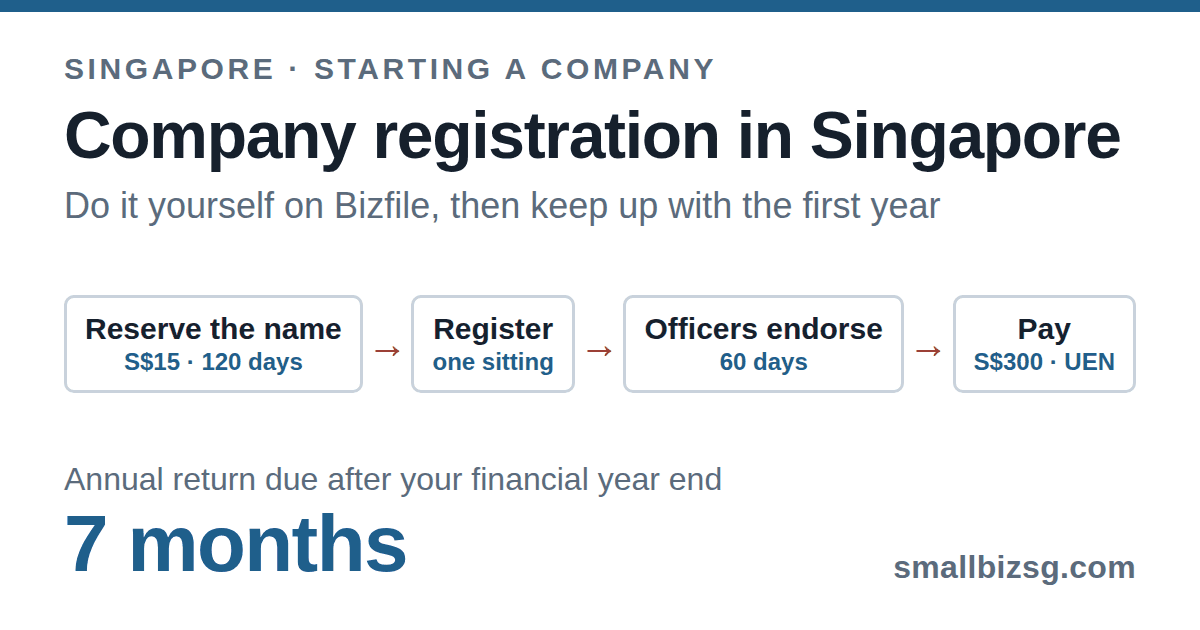
Company registration in Singapore costs S$315 in government fees, the same whether you do it yourself online or a firm does it for you. That’s S$15 to reserve the name and S$300 to register the company. Both go to the Accounting and Corporate Regulatory Authority (ACRA), the government body that registers businesses.
They’re paid on Bizfile, ACRA’s website for registering and filing. Most names and most registrations are approved soon after payment.
To do it yourself you need Singpass, the login individuals use for government digital services. The company needs a resident director and an official address here; the list in the next section has the rest. It also needs at least S$1 of capital: money its shareholders agree to invest in it for their shares, not a fee.
A company secretary, the officer who maintains the company’s registers and reminds the directors of filing deadlines, must be appointed within six months of registration. The secretary must be resident here and can’t be the company’s sole director, so a one-person company needs a second person. To register, foreigners must, in ACRA’s words, engage a corporate service provider: a firm registered with ACRA that can file on a client’s behalf.
Registration is the easy part; the first year has a series of deadlines. Every year, within seven months after its financial year end, the company files an annual return. That’s the online form that keeps its details on ACRA’s public record up to date.
The company pays ACRA S$60 to file each annual return. Its tax return is due by 30 November of the calendar year after the one its financial year ends in. For a financial year ending in June 2025, that’s 30 November 2026.
A company that files its annual return late pays a late-filing penalty in addition to the S$60. It’s S$300 if the return is up to three months late, and S$600 instead if it’s later. The calendar further down gives the date of every step for one invented example company.
I’ve registered a sole proprietorship, a business with one owner, by myself on Bizfile, and a private limited company through a corporate service provider. The provider did the paperwork; the deadlines stayed mine.
Every fee and deadline below links to the government’s own page for it, mostly ACRA’s or the tax authority’s. All were checked on 15 October 2026. This is sourced information, not advice, drafted with AI assistance and checked by me.
- What you must have before you touch Bizfile
- The four Bizfile steps and what they cost
- How my two registrations went, and what came after
- What a provider does for you, and what it can’t
- What the first year asks of you, on a calendar
- What a late annual return costs, and the other penalties around it
- What a dormant company still has to file
What you must have before you touch Bizfile
Five things, and a sixth within six months of registration. Most are on the list of what to prepare in ACRA’s registration guide, along with smaller items such as a company email.
- A resident director. Every director must be 18 or older, and at least one must meet ACRA’s local residency rules. ACRA’s requirements page lists who meets those rules: Singapore citizens, Singapore permanent residents, and valid holders of an Employment Pass, Personalised Employment Pass or Overseas Networks & Expertise Pass.
- A registered office, the company’s official address in Singapore, where ACRA sends notices and the company keeps its records. From 20 October 2026 the company sets its office hours itself, ACRA says; there’s no longer a minimum number of office hours each business day. After someone gives reasonable notice, records open to inspection must be available “for at least two hours during each of the relevant business days”. Bizfile’s free search shows the address to anyone.
- Share capital of at least S$1. Share capital is the amount shareholders agree to invest for their shares, and ACRA’s share capital page sets its minimum at S$1. Shares can be issued without full payment: paid-up capital is the part the shareholders have actually paid. The directors or the secretary update Bizfile within 14 days of any change to the company’s shares, such as new shares, or full payment for a share that was partly paid.
- A constitution, the rules for running the company: upload your own, or adopt the model constitution, the standard rules set out in the Companies (Model Constitutions) Regulations 2015. With the model, you choose whether the company follows any future changes made to the model under the Companies Act, or keeps the model as it was when the company was registered. Whichever constitution the company uses, keep a copy at the registered office, signed by all the shareholders the company starts with.
- A business activity code. Every company classifies its main activity with a five-digit Singapore Standard Industrial Classification (SSIC) code, picked when you reserve the name; ACRA’s SSIC page shows how. Some activities need a licence or approval before you start, and ACRA’s name reservation page sends you to GoBusiness to check.
- A company secretary within six months of registration. A real person, resident here, and not the sole director. If the position stays empty for more than six months, the director may face a fine of up to S$1,000.
On foreigners, ACRA’s requirements page says they must engage a corporate service provider to reserve the name and register. A foreigner moving here to run the business needs a work pass.
Pass holders should check with the agency that issued their pass before registering a business or taking a role in one. Employment Pass holders, for example, must first seek a Letter of Consent from the Ministry of Manpower.
One more decision goes on the form: the financial year end, the last day of the period the company’s accounts cover. ACRA’s financial year end page says any date works; 31 March, 30 June, 30 September and 31 December are common. A company that misses a deadline set by its year end can’t change the year end, so read the calendar further down before you choose.
The year end sets the deadlines for the annual return, seven months after it, and for the annual general meeting (AGM), six months after it. That’s the meeting where the company presents its financial statements, its accounts for the year, to the shareholders. Preparing the financial statements is among the directors’ duties.
If you’re still weighing a company against a sole proprietorship, that comparison is its own post. This one assumes you’ve decided.
The four Bizfile steps and what they cost
Two payments, S$15 and S$300, and two waits: ACRA’s review, and endorsement by the other position holders (ACRA’s name for the company’s officers and shareholders). To endorse, each one confirms their own role in the company on Bizfile. You log in to Bizfile with Singpass as an individual.
| Step | Fee | How long | What you get |
|---|---|---|---|
| 1. Reserve the name | S$15, non-refundable | Most are approved soon after payment; up to three working days if ACRA reviews the name, up to 15 if it goes to another agency | A transaction number; the name is held for up to 120 days |
| 2. Register the company | Nothing yet; the S$300 is paid at step 4 | Up to you | An application waiting for endorsement |
| 3. Other position holders endorse | No fee | 60 days from their notification, or the application lapses | A payment notification in your Bizfile inbox |
| 4. Pay, then ACRA reviews | S$300 | Most approvals soon after payment; complex cases may take up to 15 working days; referrals 14 to 60 days | The notice of incorporation, the unique entity number (UEN), the number the company uses with government agencies, and a free copy of the business profile, a summary of the company’s registered details |
Sources: ACRA’s name reservation, registration and free business profile pages.
1. Reserve the name
Check the name isn’t taken with Bizfile’s “Search for business information”, using the Entity and Reserved name searches together, as ACRA’s search guide advises. Then apply without “Pte Ltd” at the end of the name, with your SSIC code.
ACRA’s name rules tell you to avoid offensive names and names close to a government body’s. A name identical to an existing one will likely be rejected; if it is the name of a sole proprietorship you own, see below.
Some words send the name to another authority, “bank” or “architect” among them, and only registered architects may use “architect”. The name application can then take up to 15 working days. ACRA’s registration guide says a registration needing a referral authority’s approval takes 14 to 60 days.
If you already run a sole proprietorship, ACRA may let the company take the same name. Send a letter of consent for the name from the sole proprietorship’s owner with the name application. That owner is you; the sole proprietorship vs company post explains the letter and the order of the steps.
Save the transaction number from Bizfile’s approval notification: you need it to register within 120 days. The same notification gives the date the reserved name expires, and after 120 days the name is released for others to use.
2. Register the company
Only the person who reserved the name can register, and they must become a director or secretary of the new company. You can also have a corporate service provider do both steps for you. You enter:
- the name’s transaction number, which fills in key details for you;
- the financial year end, a company email, the office hours and the registered office address;
- each position holder’s NRIC or FIN, full name, date of birth and residential address;
- the share capital and who holds the shares;
- the registrable controllers: the people or companies with significant ownership of or control over it, for most companies its shareholders;
- the constitution.
The controllers’ details go to ACRA’s central register with the registration. They also go into the company’s own register of controllers, a private list it keeps from the day of incorporation.
3. Other position holders endorse
After you submit, each other position holder gets a notification in their Bizfile inbox and has 60 days to endorse, or the application lapses. Only the others endorse, so a sole director and shareholder with no one else on the form has no one to wait for. A provider filing for you skips the step.
4. Pay, then ACRA reviews
Once all endorsements are in, the payment notification arrives and you pay the S$300. Approval brings the notice of incorporation, the UEN for dealing with government agencies and a link to the free business profile.
The person who filed gets the free copy in their Bizfile inbox within 15 minutes of approval and can download it for 60 days. After that, or for anyone else, a profile costs S$5.50, on ACRA’s information products page. Certificates, which show certified information about a company, are a separate product, from S$11.
The day after the UEN arrives, the company can apply for Corppass, the system a company uses to give people access to its government services. ACRA’s post-registration guide marks Corppass as required but sets no deadline for it; you’ll need Corppass to file the annual return yourself. The same guide says the company can open a bank account straight after registration; banks usually want a board decision and certified company documents.
How my two registrations went, and what came after
What follows is from my own inbox and from Bizfile’s record of the company.
The sole proprietorship, by myself. I registered it in 2024, on Bizfile with Singpass. ACRA’s name approval and its “business entity is registered” notice both arrived by email the same day.
The private limited company, through a provider. Later in 2024 a corporate service provider incorporated the company for me. A secretary from the provider’s own staff was appointed at incorporation, and a paid address, not the provider’s, became the registered office. The constitution and the business profile arrived by email once the registration was through.
What came after. ACRA’s first email came within weeks of incorporation: an automatic reminder to keep a register of registrable controllers. The bank account came a few weeks later, applied for and opened online without a branch visit.
Corppass was set up months after the UEN arrived; ACRA’s guide marks it as required but sets no deadline. Then the calendar took over.
What a provider does for you, and what it can’t
A provider is for the parts you can’t supply yourself. Since 9 June 2025, under the Corporate Service Providers Act 2024, every business providing corporate services in and from Singapore must be registered with ACRA.
To check a provider is registered, search Bizfile’s Entity tab by name, or by UEN with “Keyword match type” set to “UEN (including previous UEN)”. ACRA’s search guide says a registered provider’s details show at the bottom of its profile. Logged in to Bizfile, my own company’s record names its provider under “My Corporate Service Provider”.
| Doing it yourself | Through a provider | |
|---|---|---|
| Who applies for the name and registers | You, logged in with Singpass; you then become a director or the secretary | The provider, logged in with Corppass |
| Government fees | S$315 | S$315 |
| Endorsements | Every other position holder, within 60 days | Not needed |
| Annual return | Filed by an officer, such as the director or secretary | Officers or the provider can file it |
| Late filing | Enforcement action against the company and its officers | The same |
Sources: ACRA’s name reservation, registration, fees, steps-to-file and penalty pages.
What a provider does. ACRA’s pages say a provider can apply for the name, register the company and later file the annual return. Mine did all three and supplied the secretary, in place on day one. The annual return still went in late, as the penalty section tells.
What stays your job. ACRA’s page on annual return deadlines puts it in one sentence: “As a director, it is your legal duty to file on time.” Its penalty page says late filing can lead to enforcement action against the company and its officers.
Who can file the tax return. Filing the annual return doesn’t file the tax return, which goes to the Inland Revenue Authority of Singapore (IRAS), the government’s tax authority. ACRA’s steps page says the company must still file its taxes unless IRAS has excused it from filing.
Whoever files it must be authorised by the company in Corppass as an “Approver” for IRAS’s Corporate Tax (Filing and Applications) service. This applies to an outside firm too, and the steps come in this order:
- The company sets up Corppass, from the day after its UEN arrives.
- In the Corppass portal, the company authorises the firm for that service, with the Approver role.
- Corppass then lists the services each authorised firm can use; check that list before the first tax return is due.
The cost line. Registering costs S$315 whoever files it; a provider charges extra for the secretary, the address and the filings. Those fees are the real difference between the two routes, and I’m not quoting mine, because I can only vouch for ACRA’s fees. What you buy from a provider is convenience and a person who knows the forms; the deadline stays yours.
What the first year asks of you, on a calendar
Most deadlines count from two dates: the day of incorporation, when ACRA registers the company, and the financial year end set on the registration form. The calendar applies today’s rules to the invented example company this site uses in its posts. It’s a one-person private limited company incorporated on 15 July 2024 with a 30 June year end, whose director is its only shareholder.
Its dates are invented: its incorporation date, its year end and every date worked out from them. The rules are ACRA’s and IRAS’s, linked in the table below. Its first financial year runs from 15 July 2024 to 30 June 2025, the year end set on its registration form.
Each later year ends on 30 June too. A company incorporated now takes the same steps from its own dates: the table’s first column says when each is due.
The example company’s first year: incorporated 15 July 2024, year end 30 June.
From the day of incorporation
- 15 July 2024The day of incorporationRegister of controllers set up; the controllers’ details go to ACRA with the registration
- 16 July 2024Any time from the next dayApply for Corppass
- By 15 October 2024Within three monthsAppoint an auditor, unless the company qualifies as a small company
- By 15 January 2025Within six monthsAppoint the company secretary
Before the company starts operations: appoint a data protection officer, the person who handles its personal-data questions.
From the first year end, 30 June 2025
- By 30 September 2025Within three monthsFile the estimated chargeable income (ECI), the company’s own estimate of its taxable profit, unless both are true: revenue of S$5 million or below, and an ECI of nil (zero)
- By 30 December 2025Within six monthsHold the AGM, or send the financial statements to members (shareholders) by 30 November 2025
- By 30 January 2026Within seven monthsFile the annual return, S$60
- By 30 November 202630 November of the next yearFile the first tax return
Then the same steps from every year end; the yearly notice to controllers and the changes to report are in the table below.
Today’s rules, from ACRA’s and IRAS’s own pages, linked in the table below; the dates are the example company’s. Checked on 15 October 2026.
| When, for the example company | What | Where the rule is |
|---|---|---|
| The day of incorporation (15 July 2024) | Set up the register of controllers; the controllers’ details go to ACRA’s central register with the Bizfile registration. Setting up the register on the day of incorporation is the rule for companies incorporated from 16 June 2025; the table uses today’s rule with the example’s invented date. Companies incorporated from 31 March 2017 until then had 30 days to set it up. Set up the registers of nominee directors and nominee shareholders too: people who hold the role or the shares on someone else’s behalf | ACRA, register of controllers, central register, guidance on registers of controllers, nominee directors and nominee shareholders |
| Any time from the next day (16 July 2024) | Apply for Corppass, which ACRA marks as required | ACRA, after registering |
| Before the company starts operations | Appoint a data protection officer, the person who handles its personal-data questions. Make the officer’s contact details public, on the Personal Data Protection Commission’s public list or on the company’s own website, if it has one | ACRA, after registering; Personal Data Protection Commission, Kickstart your data protection journey |
| Within three months (by 15 October 2024) | Appoint an auditor, an accountant registered with ACRA to check and report on the company’s financial statements, unless the company qualifies as a small company: a private company meeting at least two of these three: revenue of S$10 million or less; total assets of S$10 million or less; 50 or fewer full-time employees. A new company is tested on its current financial year; a company owned by another company must also meet the test as a group | ACRA, directors and officers and audit exemptions |
| Within six months (by 15 January 2025) | Appoint the company secretary | ACRA, directors and officers |
| Before the year ends (June 2025) | IRAS’s notice arrives to file the estimated chargeable income, the company’s own estimate of its taxable profit for the year (ECI) | IRAS, ECI filing and basic guide |
| Within three months of the year end (by 30 September 2025) | File the ECI, unless both are true: revenue, the income from its main business, of S$5 million or below, and an ECI of nil (zero). The company judges that itself and need not tell IRAS, even if its filing status shows “Ready to File” | IRAS, ECI filing |
| Within six months of the year end (by 30 December 2025) | Hold the AGM. A private company needn’t hold one if it sends the financial statements to all members, its shareholders, within five months (by 30 November 2025), or if all members resolve to do without AGMs | ACRA, AGM due dates and financial year end |
| Within seven months of the year end (by 30 January 2026) | File the annual return, S$60, declaring the AGM details, such as the date it was held or the date the financial statements went to members. Attach the financial statements unless the company needn’t file them (below the table) | ACRA, deadlines, steps to file, financial year end and fees |
| By 30 November of the calendar year after the year end (30 November 2026) | File the corporate income tax return for the first year; which form is in the corporate tax post | IRAS, basic guide |
| At least once a year, on any date | Send each controller a notice to confirm their details in the register, even when nothing changed; they have 30 days to reply | ACRA, annual notices |
| Within seven days of a controller telling you of a change | Update the register of controllers, then file the change with ACRA’s central register within two business days of updating it | ACRA, register of controllers |
| Within 14 days of any change | Update the registered office, business activity, officers or shares on Bizfile | ACRA, updating company information |
A private company can skip filing its financial statements if it has under 20 members and no company has a stake in it, even indirectly. It must also be able to pay its debts on time and declare this when it files its annual return. It still prepares the statements; it just doesn’t file them.
A company might not need financial statements at all if it’s dormant, which means no significant accounting transactions in the year; the dormant section explains.
The ECI and the tax return cover the same year’s income, which IRAS’s basic guide says is taxed in the following year. The example company’s first year ends in 2025, so it is taxed in 2026. What the tax comes to, with the exemptions for a new company, is a subject of its own.
What a late annual return costs, and the other penalties around it
ACRA’s penalty page sets the late lodgment penalty, ACRA’s name for the late-filing penalty, at two levels. It’s S$300 if the return is filed up to three months after its deadline, and S$600 instead if it’s filed later.
The penalty is paid in addition to the S$60 filing fee, and the company gets nothing for it. Bizfile charges it when the late return is submitted, so a return that’s already late carries the S$300 penalty until three months after its deadline.
A company that can’t meet the annual return’s deadline can apply on Bizfile for up to 60 extra days, at S$200 per application. The application must be made before the deadline, and it costs less than either penalty.
How it happened to me. The reminder came from an ACRA officer by email, after the deadline rather than before it: the annual return and the register of controllers were yet to be filed. Late filing, the email said, “is an offence under the Companies Act 1967”, and “a late lodgement penalty will be imposed”.
The return went in a few weeks later. The register of controllers did not: it stayed unlodged until I filed it myself on Bizfile, long after the deadline, and the filing carried no fee. For a company incorporated now, that first filing is part of the registration itself.
ACRA’s own example shows the company paying the late-filing penalty. ACRA can go further. Instead of prosecuting, it may offer a composition sum, a payment that settles the matter without going to court.
| If the company does not … | It can face … | ACRA’s page |
|---|---|---|
| file the annual return on time | a late-filing penalty of S$300 or S$600; if prosecuted and convicted, a fine of up to S$10,000 per charge | Penalties for late annual returns |
| hold the AGM on time | a composition sum of at least S$500 per breach, or a fine of up to S$5,000 per charge if convicted | Penalties for not holding an AGM |
| file the controllers’ details with ACRA on time | prosecution and a fine of up to S$25,000 | Central register |
| send each controller the yearly notice | a fine of up to S$25,000, for the company and the officers in default | Annual notices |
| appoint a secretary within six months | a fine of up to S$1,000, which the director may face | Directors and key officers |
ACRA disqualifies a director convicted in court of three or more filing offences in five years. It also disqualifies a director who had three or more companies struck off by ACRA, meaning removed from its register, in that time.
What a dormant company still has to file
A dormant company still files an annual return every year, and a tax return every year unless IRAS has granted a waiver. Registering a company you don’t yet trade through doesn’t pause the calendar; it only shortens some of the forms.
ACRA’s side. ACRA’s annual return deadlines page says every company with live status must file one each year, inactive or dormant included. Its financial statements page counts a company as dormant when it “has no significant accounting transactions during the financial year”. An accounting transaction is “one that affects the financial statements of a company”; the page doesn’t say which ones are significant.
Three things get easier:
- A dormant private company that is neither listed nor a listed company’s subsidiary, with total assets of S$500,000 or less, needn’t hold an AGM.
- If it has been dormant since it was formed or since the end of the previous financial year, and its total assets never passed S$500,000 during the year, it needn’t prepare or file financial statements.
- ACRA’s audit page adds that a dormant company doesn’t need an audit.
IRAS’s side. For IRAS, a dormant company carries on no business and has no income for the whole period its tax return covers (dormant companies page). Even interest from a deposit ends that. The two tests differ, so a company can be dormant for one and not the other.
Under either test, a dormant company must still file its tax return each year, unless IRAS has granted a waiver. Each tax return is due by 30 November of the calendar year after the one in which its financial year ends. There’s a simplified form for it: IRAS’s filing reminder to my company calls the dormant-company form one with “only two essential fields”, and adds that on-time filing is required even if the company did not carry on business.
With no income, a dormant company meets both parts of the ECI test above, so it can skip the ECI without telling IRAS.
IRAS’s waiver from filing the tax return has four conditions, all on its dormant companies page. Among them, the company must be dormant by IRAS’s test, and must not intend to start business again within the next two years. A company dormant since it was incorporated can apply too, if it’s likely to stay dormant for at least the next two years.
Where these facts came from
The table pairs each fact above with the official page it came from, for anyone who wants to check. Every page was opened on 15 October 2026 except one, opened on 20 October 2026: ACRA’s announcement of that day’s changes. Of the pages’ own dates, the oldest is 16 June 2025 and the newest 14 October 2026.
What I say about my own sole proprietorship and company comes from ACRA’s and IRAS’s notices to them, my own inbox and Bizfile’s record of each.
| What | Pages |
|---|---|
| Who can register: every director 18 or older, at least one meeting the local residency rules; who counts as a local resident; foreigners engage a corporate service provider and need a work pass; the Letter of Consent for Employment Pass holders; a secretary within six months, a real person, resident, not the sole director, and the S$1,000 fine; what a secretary does; an auditor within three months; nominee directors | ACRA — Requirements and eligibility, Directors and key officers, Registering via Bizfile |
| The name: checking availability with the Entity and Reserved name searches; the rules; referral words (up to 15 working days for the name); the S$15 fee, non-refundable; most names approved soon after payment, up to three working days for a review; up to 120 days, and the approval notification with the transaction number and the name’s expiry date; the letter of consent for an identical name; SSIC codes; licences and GoBusiness | ACRA — Using Bizfile’s search functions, Choosing a business name, Referral authorities, Reserving a name via Bizfile, Applying for a new business entity name, Finding the right SSIC code |
| The form: the financial year end (the last day of the company’s accounting period; any date; 31 March, 30 June, 30 September and 31 December common), with the AGM six months and the annual return seven months after it, the worked dates for a 30 June year end, and no change after a missed deadline; share capital, paid-up capital and the S$1 minimum; nominee shareholders; the constitution and the model constitution’s two options; the signed copy | ACRA — Choosing a financial year end, Share capital and share types, Company constitution |
| Registering via Bizfile: what ACRA and Bizfile are; S$300; who can file; Singpass for individuals and Corppass for providers; the registered office; position holders; what you enter; the controllers entered at registration; the 60-day endorsement, each position holder confirming their own role on Bizfile, and the lapse; payment after endorsement; approval times; what arrives, the UEN for dealing with government agencies; a registered provider’s details on its Bizfile profile | ACRA — Registering via Bizfile, Using Bizfile’s search functions, Endorsing new business registrations, Overview of ACRA, Bizfile |
| The registered office from 20 October 2026: office hours set by the company, with no minimum each business day; records open to inspection “for at least two hours during each of the relevant business days”, after reasonable notice | ACRA — Changes from 20 October 2026 |
| Business profiles and fees: free within 15 minutes, to the filer, for 60 days, otherwise S$5.50; certificates from S$11; Bizfile’s free search, with no login, showing the registered address; S$15, S$300 and S$60; the S$315 set-up fee, and a sole proprietorship’s single owner | ACRA — Downloading free business profiles, Types of information products, Service and transaction fees, Choosing a business structure |
| After registering: Corppass, required, from one day after the UEN; the bank account and what banks usually want; the registers from the day of incorporation; the controllers’ register the same day for companies incorporated from 16 June 2025, with the controllers filed in the Bizfile registration, and 30 days for companies incorporated from 31 March 2017 until then; who controllers are; seven days to update the register, from when a controller tells you, and two business days to file a change; the annual notice at least once a year and 30 days to reply; the data protection officer before operations; changes within 14 days, reported by the directors or secretary; fines of up to S$25,000 for not filing with the central register or not sending the annual notice | ACRA — After registering a local company, Setting up and maintaining the register of controllers, Filing with the Central RORC, Guidance on registers of controllers for companies, Identifying and sending annual notices, Updating company information |
| Annual returns: what one is; within seven months, S$60; every live company, dormant ones included; the director’s duty; officers or a provider can file, through Corppass; the AGM details on the return; the taxes still to file unless waived; up to 60 extra days for S$200, applied for on Bizfile before the deadline; penalties of S$300 or S$600, paid in addition to the S$60 fee and applied on submission, paid by the company in ACRA’s example; composition sums; fines of up to S$10,000 per charge; disqualification after three filing convictions, or three companies struck off by ACRA, in five years | ACRA — Annual return deadlines, Steps to file the annual return, Penalties for late annual returns, Applying for an extension of time; Singapore Statutes Online — Companies (Fees and Late Lodgment Penalties) Regulations 2015, regulation 4 |
| AGMs: what one is; within six months; the private-company alternatives, financial statements within five months or a resolution to do without; dormant private companies with assets of S$500,000 or less; composition sums of at least S$500 and fines of up to S$5,000 per charge | ACRA — AGM due dates, Penalties for not holding an AGM |
| Audit and financial statements: what an auditor does, and that auditing needs registration with ACRA as a public accountant; the small-company test (at least two of revenue S$10 million, assets S$10 million, 50 full-time employees), for new companies on the current year and for groups; the dormant company’s audit exemption (section 205B); which companies prepare and file financial statements; the solvent private company with fewer than 20 members and no corporation holding an interest in its shares, and its declaration of solvency with the annual return; ACRA’s definition of dormant; no financial statements for a dormant relevant company (section 201A) | ACRA — Audit regulation in Singapore, Audit exemptions, Financial statements: filing requirements and exemptions |
| Providers: the Corporate Service Providers Act 2024, from 9 June 2025, under which every provider registers with ACRA | ACRA — Corporate Service Providers Act |
| Tax: what IRAS is; the ECI notice before the year ends; the ECI within three months, the S$5 million revenue and nil-ECI test, revenue meaning the main source of income, no need to tell IRAS, “Ready to File”; a financial year’s income taxed in the following year; the return by 30 November, still due from a company that carried on no business unless IRAS has granted a waiver; dormant companies, the simplified form, interest income, and the waiver’s four conditions, two years and new companies | IRAS — ECI filing, Basic guide to corporate income tax, Dormant companies, History and milestones |
| Corppass: what it is; authorising a firm for IRAS’s Corporate Tax (Filing and Applications) service, the Approver role, and each firm’s list of services | IRAS — Corppass, Guidance on filing Form C-S, C-S (Lite) and C; Corppass — Authorising a third-party entity, Viewing a third party’s authorised services |
| Data protection: what a data protection officer does; one appointed and the officer’s contact details made public, through the Personal Data Protection Commission’s DPO Registry or the company’s website | Personal Data Protection Commission — Kickstart your data protection journey |
What this post is not
I’m not a lawyer, an accountant or a corporate service provider, and nothing here is advice about your situation. It’s the registration and the first year as ACRA and IRAS describe them, with my own experience alongside.
It leaves out the foreigner’s route, beyond ACRA’s rule that a foreigner registers through a corporate service provider. What the tax comes to and registering for goods and services tax have posts of their own, and what a provider charges is left out. The choice between a sole proprietorship and a company is in the sole proprietorship vs company post.
If you take one thing from this post, put the annual return’s deadline, seven months after your company’s financial year end, in your calendar today. Put the AGM’s deadline, six months after the year end, in it too.
This post was drafted with AI assistance and checked by me against the sources above. No link here is an affiliate link and nobody paid for a mention; how this site is paid for says the rest.