The short version
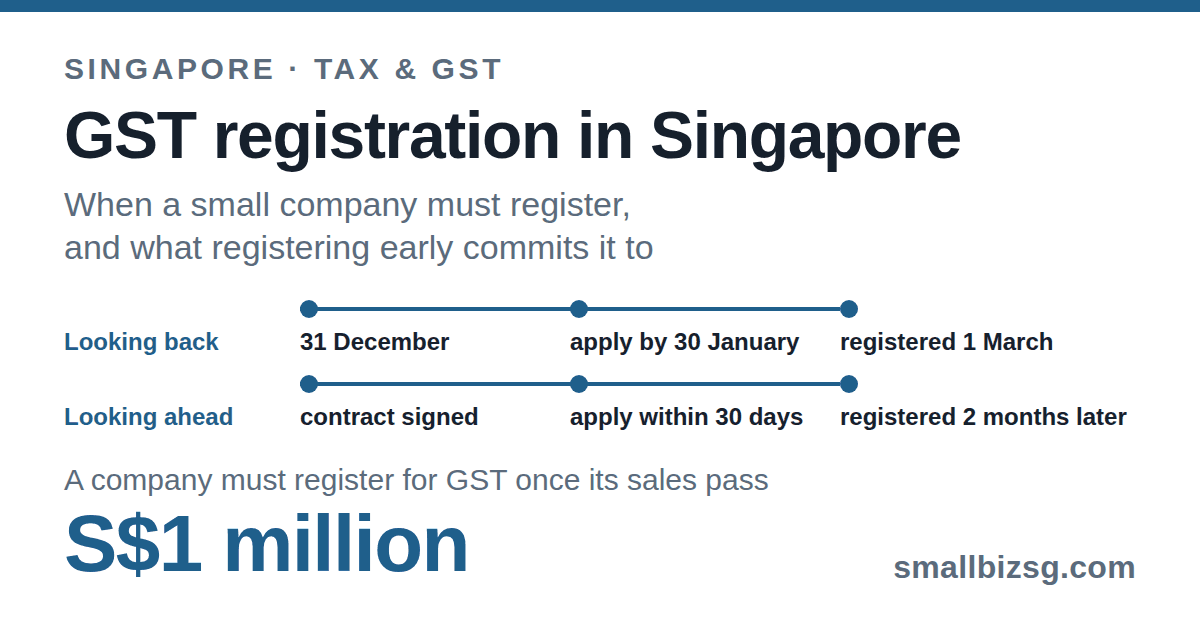
A company must register for goods and services tax (GST) once its sales pass S$1 million. GST is a tax that GST-registered businesses charge their customers and collect for the Inland Revenue Authority of Singapore (IRAS), the government’s tax authority. GST registration in Singapore follows two tests, and either one is enough:
- Looking back: the company’s sales for the last calendar year, January to December, came to more than S$1 million. The company applies between 1 and 30 January of the following year. It’s registered from 1 March, unless one of two exceptions, explained below, applies.
- Looking ahead: paperwork shows the company’s sales can reasonably be expected to pass S$1 million in the next 12 months. A signed contract can show this, and so can accounts showing the past 12 months’ sales close to S$1 million and rising. The company applies within 30 days of the day it could first expect this, such as the day it signed the contract. It’s registered two months after the day it could first expect this.
Not every sale counts towards the S$1 million; the next section explains which.
A company below S$1 million on both tests doesn’t have to register under them yet. But it checks the look-back test again every 31 December, and the look-ahead test can catch it on any day.
A company below S$1 million can also register early, by choice. Once registered, a company charges GST on what it sells and claims back the GST on what it buys.
A company registering by choice must stay registered for at least two years. It must also pay GST by GIRO: IRAS takes the money from the company’s bank account automatically.
A company applying by choice on or after 1 April 2026 must also send its invoice data to IRAS through InvoiceNow. That’s the nationwide network for sending invoices digitally. A company that must register joins it later.
Until it’s registered, a company must not charge GST or issue a tax invoice, the invoice a GST-registered customer needs to claim back GST.
Anyone can check whether a business is GST-registered on IRAS’s GST Registered Business Search.
Each rule is linked to its source, one of IRAS’s pages or the GST Act, the law behind GST. Every page was read on 16 October 2026.
This is information from those pages, not advice about your own company. It was drafted with AI assistance and checked by me.
- Which sales count towards S$1 million
- When a company must register: looking back, and looking ahead
- What happens if a company registers late
- What a company can’t do before it’s registered
- How to check whether a business is GST-registered
- What registering early commits a company to
- How a company applies
Which sales count towards S$1 million
Only the sales that GST applies to count, and IRAS calls them taxable turnover. Its page “Do I need to register for GST” warns against adding up every sale: “you should look at the taxable turnover and not sales”. From here on, when this post says “sales”, it means taxable turnover only, as IRAS asks.
Sales of goods and services in Singapore count, and they carry GST at 9%. Exports of goods and international services, such as an air ticket from Singapore to Thailand, count too: GST applies to them, at 0%.
Three kinds of sale don’t count towards the S$1 million:
- sales that GST doesn’t apply to at all, which IRAS calls exempt, such as selling or renting out homes, and most financial services; they’re not the same as sales at 0%;
- sales of goods that never enter Singapore, or only pass through it in transit;
- sales of equipment and property the company uses, rather than keeps to sell, such as machinery, an office building or furniture (IRAS’s examples).
A company counts only its own sales, because the law treats it as a separate person from its directors. An earlier post on this site, Sole proprietorship vs Pte Ltd, explains that difference.
Does a director have to register for GST personally, on director’s fees? An executive director, one employed by the company, doesn’t: IRAS’s page says their services are part of the job, “in the course of your employment”. A non-executive director, one not employed by it, may have to register if they supply their services themselves, as part of a business.
When a company must register: looking back, and looking ahead
This section runs both tests for one example company, whose dates, figures and contract are invented. It’s a private limited company with one director, who is also its only shareholder. It was set up on 15 July 2024, and its financial year, the 12 months its yearly accounts cover, ends on 30 June.
It isn’t registered for GST.
Two ways a company can become required to register for GST
Either one is enough. Shown for the example company; its dates and contract are invented.
1Looking back: last year’s sales passed S$1 million
Add up the sales from January to December. The company’s own financial year doesn’t matter here.
- 31 December 2025The year closes with more than S$1 million of sales
- 1 to 30 January 2026Apply for GST registration
- 1 March 2026Registered, and charges GST from this day
2Or instead, looking ahead: a signed contract will take sales past S$1 million
It takes paperwork, such as a signed contract, or accounts showing the past 12 months’ sales close to S$1 million and rising. A sales target or a business plan isn’t enough.
- 10 March 2026Signs a contract worth S$1.2 million over the next 12 months
- By 9 April 2026Apply for GST registration, within 30 days of signing
- 10 May 2026Registered, two months after signing
“Sales” here means the sales that count for GST; the text explains which. Rules from IRAS’s page “Do I need to register for GST”. Checked on 16 October 2026.
The look-back test counts sales from 1 January to 31 December. IRAS’s page tells a business to assess its “taxable turnover for the calendar year (i.e. for the period 1 Jan to 31 Dec)”. Each year is tested when it ends, on 31 December.
Every calendar year is tested, even one the company started partway through. The example company’s first calendar year, 2024, counts only its sales from 15 July 2024; suppose they stayed below S$1 million.
Then take 2025, its first full calendar year: 1 January 2025 to 31 December 2025. That year doesn’t match its financial year, which ends on 30 June. So its yearly accounts won’t give the number: it adds up its sales for each month from January to December 2025.
Suppose those sales passed S$1 million. The company then had to apply between 1 and 30 January 2026, and was registered from 1 March 2026.
The application form asks for the calendar year in which sales passed S$1 million.
The look-ahead test can catch a company on any day of the year. A company must register once it can reasonably expect more than S$1 million of sales in the next 12 months. It applies within 30 days of the day it could first expect this, such as the day it signed the contract.
The expectation needs paperwork. IRAS gives these examples:
- signed contracts or agreements;
- quotations the customer has accepted, or orders the customer has confirmed;
- invoices to customers for a fixed monthly fee;
- accounts showing the past 12 months’ sales already close to S$1 million, and rising.
IRAS gives no figure for “close”; in its own example, a business’s sales for the past 12 months were S$900,000, rising by 15% a year. So the next 12 months should pass S$1 million: 15% more than S$900,000 is S$1,035,000.
IRAS gives 15 January 2026 as the day the business could first expect this. So it had to apply by 14 February 2026, and was registered from 15 March 2026.
A business plan, a market study or a sales target isn’t enough for this test. IRAS’s page says that if the expectation isn’t certain, as with one based on those, the company doesn’t have to register under this test. It still checks the calendar year at 31 December, and applies by 30 January if that year passed S$1 million.
A company that applies anyway, without that paperwork, is treated as registering by choice.
Suppose instead that the example company signed a 12-month contract worth S$1.2 million on 10 March 2026. It then had to apply within 30 days of signing, by 9 April 2026. It was registered two months after signing, from 10 May 2026.
If you open IRAS’s page, you’ll see an older rule first: registration on the 31st day after the expectation began. That rule is only for companies whose expectation began before 1 July 2025. From that date, it’s two months, as the page says further down.
IRAS lists two exceptions. A company whose sales are all or mostly at 0%, such as exports, may ask IRAS not to register it.
And a company that passed S$1 million last year need not register if paperwork shows the next 12 months’ sales won’t pass S$1 million. The fall in sales needs a specific cause, such as a major customer’s large contract ending, or a large cut in the business. The company keeps that paperwork, with a detailed calculation, and checks its sales again at the end of the next calendar year.
What happens if a company registers late
IRAS registers it from the date it should have been registered, not the date it applied. The company then owes GST on its sales from that date, whether or not it collected any from its customers.
Customers who agree may pay that GST; the company bills them with tax invoices, as IRAS’s page explains. For customers who don’t agree, the GST comes out of the company’s own pocket.
IRAS’s page also warns of a fine of up to S$10,000 and a penalty of 10% of the GST due. The company may also be taken to court.
If a company that applies late says so in its application, IRAS says it generally doesn’t have to pay the fine and penalties. It still owes the GST. If it has trouble paying the GST for the past months, IRAS may let it pay in instalments, a part at a time.
The GST Act makes failing to register an offence, with the same fine of up to S$10,000 and 10% penalty. In the Act, they apply when a court finds the company guilty. A further S$50 can then be added for every day the offence continues after that finding.
Take the example company’s look-back case. If it applied after 30 January 2026, its registration would still start on 1 March 2026. It would owe GST on its sales from that day, even if it had charged its customers none.
What a company can’t do before it’s registered
Only a GST-registered business can charge GST or claim it back. It can do so only from the day its registration starts, IRAS says. Applying changes nothing: a company waiting for approval charges GST only from the start date its approval letter gives.
So, until it’s registered, a company:
- must not charge GST, whatever its sales;
- must not issue a tax invoice, as IRAS’s General Guide for Businesses says;
- can’t claim back the GST it pays on its own purchases.
The GST its suppliers charge is then a cost to it. Once registered, by choice or not, it can claim GST back in its GST returns, the forms where it reports GST charged and paid. What it can claim includes some GST paid before registering, as the end of the section on registering early explains.
The GST Act makes it an offence for a business that isn’t registered to collect, or try to collect, “any amount as tax”. If a court finds it guilty, the penalty is three times the amount collected, plus a fine of up to S$10,000. If the business was careless, or had no reasonable excuse, jail of up to three years is also possible.
A company can’t be jailed. But the Act treats its directors as guilty too, unless they can prove two things. First, they didn’t agree to the offence or quietly allow it; second, they did all they should to prevent it.
A company that charged GST without being registered must pay all of it over to IRAS. It also makes a voluntary disclosure, the name for coming forward to tell IRAS about the mistake. IRAS’s page sets out the steps:
- the company fills in the page’s form, “Voluntary Disclosure for Wrongful Collection of GST”;
- it sends the form with a list of those sales and a copy of one of the invoices;
- then it pays the GST by internet bank transfer, as the form explains, and keeps proof of the payment.
IRAS’s page doesn’t say whether coming forward changes the Act’s penalties.
How to check whether a business is GST-registered
Check before you pay. A supplier that isn’t registered isn’t allowed to charge GST, so GST on its invoice is a reason to look it up. Your customers can check your company the same way; until it’s registered, its invoices must carry no GST.
Use IRAS’s GST Registered Business Search, on myTax Portal, IRAS’s website for tax matters. The search is open to the public and needs no login.
You can search by one business name, or by up to four numbers. Each can be a Unique Entity Number (UEN), the number every Singapore company is registered under, or a GST registration number.
A registered supplier prints its GST registration number on its tax invoices, and that number may or may not be the same as its UEN. Searching by the number on the invoice, or by the supplier’s name, covers both cases.
What registering early commits a company to
A company below S$1 million can register early, by choice, if it makes sales that GST applies to. One that hasn’t started selling yet may still apply if it has definite plans to. Without definite plans, IRAS says, it “should not apply”.
Four things a company registering by choice does
- Before applying, a director, or whoever will prepare the GST returns, completes IRAS’s online course “Overview of GST” and its quiz. It’s not needed if a director has experience managing another business that’s GST-registered. Nor is it needed if the returns are prepared by a tax professional certified as an Accredited Tax Adviser or Accredited Tax Practitioner.
- It applies for GIRO, so that IRAS takes GST from its bank account and pays refunds into it. On the registration form, it promises to apply for GIRO immediately. Unless the GIRO form is submitted within 10 working days, the GST registration application is treated as cancelled. IRAS suggests eGIRO, the online version, for a faster approval.
- It provides a guarantee if IRAS asks for one, after judging the risk of the application; the guarantee usually covers two years. IRAS sets the amount, and digital guarantees can be bought from several financial institutions.
- Before applying, it sets up software that works with InvoiceNow and gets a Peppol ID, the ID that identifies it on InvoiceNow. The software’s provider sets up the Peppol ID, using the company’s UEN. The form asks for the Peppol ID if the company must use InvoiceNow. A company applying by choice on or after 1 April 2026 must use it.
IRAS’s InvoiceNow page points to a list of approved software and to free basic packages.
A company that has to register joins InvoiceNow later. IRAS’s page applies it to those applying from 1 April 2028 and, in stages until 2031, to businesses already registered.
Once registered: conditions and tasks
IRAS sets conditions for registering by choice:
- The company stays registered for at least two years and keeps paying by GIRO while it’s registered. If it hadn’t started selling when it applied, IRAS’s conditions require it to start within two years, or longer if IRAS agrees.
- It sends its invoice data through InvoiceNow, with its software’s sending feature switched on. This covers every business applying by choice on or after 1 April 2026, however long it has existed, though overseas businesses are left out.
Like every GST-registered business, it also has these tasks:
- It files a GST return for every three months or every month, choosing on the form from the options its financial year end allows. Each return, with any GST to pay, is due one month after the period ends, even when there’s nothing to report. A return for January to March is due by 30 April.
- It gives GST-registered customers a tax invoice, in general within 30 days of the sale. Prices it shows or quotes to the public include GST, and it keeps its records for at least five years.
Filing or paying late has its own costs:
| If | What it can cost |
|---|---|
| A return isn’t filed by the due date | S$200 at once, then S$200 for each full month it stays unfiled, up to S$10,000 a return |
| A company repeatedly fails to file | Not filing is an offence: a notice to attend court may follow, and a fine of up to S$5,000 for each offence if the company is found guilty |
| GST is paid late | A 5% penalty on the tax unpaid by the due date |
| GST is still unpaid 60 days after the 5% penalty is imposed | A further 2% may be added for each month it stays unpaid, up to 50% of the unpaid tax. The months count from the date the GST was due |
Here is the whole change at a glance:
| What changes | Not registered | Registered, by choice or because it must |
|---|---|---|
| GST on its sales | Must not charge it | Charges 9% on sales in Singapore |
| Tax invoices | Must not issue them | Gives them to GST-registered customers, in general within 30 days |
| GST on its purchases | Can’t claim it back | Claims it back in its returns |
| GST returns | None | Every three months or every month, each due one month after the period, even with nothing to report |
| GIRO | Not needed | By choice: needed for payments and refunds. Because it must: if IRAS asks |
| IRAS’s online course | Not needed | By choice: before applying, unless an exception applies. Because it must: not needed |
| A guarantee | Not needed | If IRAS asks for one |
| InvoiceNow | Not needed | By choice: needed for applications from 1 April 2026. Because it must: needed for applications from 1 April 2028; businesses already registered join in stages until 2031 |
| How long it lasts | No commitment | By choice: at least two years before it can cancel. Because it must: it may apply to cancel once it’s no longer required to register |
What registering does to price and profit: IRAS’s S$200 example
One thing that decides what registering does to profit is whether the company can add GST to its prices. IRAS’s own example: a company buys goods for S$100 from a supplier that charges no GST, and sells them for S$200.
| What happens | Before registering | Registered, GST added on top | Registered, price kept at S$200 |
|---|---|---|---|
| The customer pays | S$200 | S$218 | S$200 |
| GST in that price, paid to IRAS | None | S$18 | S$16.51 |
| The goods cost | S$100 | S$100 | S$100 |
| Profit on the sale | S$100 | S$100 | S$83.49 |
If the customer can pay S$218, nothing changes for the company: the extra S$18 is the GST, 9% of S$200, and goes to IRAS. Customers who are GST-registered may accept this, because they may be able to claim the S$18 back.
If competition keeps the price at S$200, the GST has to come out of the S$200. A price with 9% GST in it is 1.09 times the price without. So dividing by 1.09 takes the GST out: S$200 ÷ 1.09 = S$183.49 for the company, and S$16.51 is GST.
Profit then falls from S$100 to S$83.49, which is S$183.49 minus the S$100 the goods cost.
The example assumes the supplier charges no GST. If the company’s suppliers are GST-registered, it can claim back the GST they charge once it registers, which lowers its costs.
A registration by choice starts within two weeks after the date of IRAS’s approval letter. IRAS won’t start it earlier to let the company claim back GST on past purchases. Even so, any registered company can use its first return to claim some GST paid before registering:
- GST on rent, utilities such as electricity, and other services in the six months before the registration date, unless they were directly for earlier sales;
- GST on goods bought in those six months, if the company still has them;
- GST on goods bought before those six months: all of it if unused and unsold before registering, part of it if partly used or sold.
IRAS’s example for the first item: office rent, utilities and maintenance of the premises aren’t directly for earlier sales, so their GST can be claimed.
How a company applies
First, the person applying needs access to IRAS’s “GST (Filing and Applications)” service through Corppass. Corppass is the system a company uses to give people access to its government online services. The company registration post’s first-year calendar shows when a new company can set it up.
Then the company applies online, on myTax Portal. The person applying logs in, chooses “Company/Business Tax”, then GST and “Register for GST” (IRAS’s form guide).
Filling in the form takes about 20 minutes, IRAS estimates. IRAS’s form guide lists the documents, including the company’s latest business profile. That’s the official record of the company from the Accounting and Corporate Regulatory Authority (ACRA), the government body that registers businesses.
A company that has issued invoices or made business purchases attaches recent ones. One that hasn’t yet issued an invoice, or hasn’t yet made a business purchase, attaches a detailed business plan, describing how the business will work. One using the look-ahead test attaches its paperwork, such as the signed contract.
IRAS gives two sets of times for processing an application. Once every document is in, its list of e-services gives two working days if the company must register, 10 if by choice. For applications in general, its page on applying says 60% are done within 10 working days and the rest within 30 days.
None of these pages mentions a fee for applying.
If the application succeeds, IRAS sends a letter to the company’s registered address with its GST registration number and the date registration starts. A copy also appears on myTax Portal, under “Notices/Letters”.
Below S$1 million, keep watching both tests: the look-back test every 31 December, the look-ahead test on any day.
Where these facts came from
Every page below was read on 16 October 2026, and the GST Act is quoted as it stood that day. The IRAS web pages’ own “Last updated” dates run from 26 October 2024 to 16 October 2026. IRAS’s three e-Tax Guides, its longer written guides, were published on 30 January 2026.
The example company’s dates, its 30 June year end and its S$1.2 million contract are invented. The dates that follow from them use the rules in the first row of the table below.
| What | Pages |
|---|---|
| The two tests and S$1 million; the calendar year, 1 January to 31 December, 1 to 30 January and 1 March; the look-ahead test over the next 12 months, 30 days and two months, the 31st day before 1 July 2025; the paperwork behind an expectation, quotations accepted by customers, and what isn’t enough; IRAS’s own example: S$900,000, 15% a year, 15 January 2026 as the day the business could first expect to pass S$1 million, 14 February and 15 March 2026, with S$1,035,000 worked out in this post; the exceptions, their causes, the paperwork and calculation kept, and the next calendar year; taxable turnover and what it leaves out; a company’s own sales; directors’ fees, executive and non-executive; backdating, the S$10,000 fine, the 10% penalty, court, billing customers who pay, with tax invoices, the waiver and instalments | IRAS — Do I need to register for GST (15 September 2026) |
| No GST before registration starts; registration within two weeks after the approval letter’s date, and not started earlier to claim GST on past purchases; 60% within 10 working days and the rest within 30 days; eGIRO; the course’s exceptions; the approval letter, its start date and its copy on myTax Portal | IRAS — Applying for GST registration (15 September 2026) |
| The calendar year and the financial year end on the form, and the return periods it offers, every three months or every month; the route on myTax Portal; the documents: the business profile, invoices, a business plan and what it describes where there’s no invoice or purchase yet, and the look-ahead paperwork; the promise to apply for GIRO immediately, and the registration application cancelled after 10 working days without the GIRO form; GIRO and a guarantee if IRAS asks; the course done by a director or the preparer, and only for registering by choice; InvoiceNow software and the Peppol ID before applying; applying without paperwork treated as registering by choice | IRAS — Guide to completing GST registration form (14 September 2026) |
| Who may register by choice; definite plans; goods that never enter Singapore or are in transit; GST-registered customers and the price; the S$200 example: S$100 from a supplier charging no GST, S$218, S$18 (9% of S$200), S$16.51 and S$83.49, with S$183.49 (S$200 ÷ 1.09) worked out in this post; the two years; the course before applying, and its exceptions; GIRO; the guarantee: IRAS’s risk check, two years, the amount, digital guarantees; starting sales within two years; GIRO kept while registered; applying to cancel once no longer required to register | IRAS — Factors to consider before registering voluntarily for GST (30 January 2026), Cancelling GST registration (14 September 2026), e-Learning course “Overview of GST” (19 January 2026), e-Tax Guide: Conditions for GST Voluntary Registration (30 January 2026), Guarantee (26 October 2024) |
| InvoiceNow: Singapore’s network for sending invoices digitally; 1 April 2026 for registering by choice, overseas businesses left out; 1 April 2028 for companies that must register, and stages until 2031 for businesses already registered; invoice data sent to IRAS from software that works with it; the approved list; free basic packages; the Peppol ID from the software provider; the sending feature | IRAS — GST InvoiceNow Requirement (8 October 2026) |
| The conditions of registering by choice and the tasks of every registered business; returns and payment one month after the period, by 30 April for January to March, even with nothing to report, GIRO deductions; prices to the public with GST; records for five years; tax invoices within 30 days; the UEN and the GST registration number; the 9% and 0% rates | IRAS — Responsibilities of a GST-registered business (13 August 2026), GST filing due dates and requests for extension (9 October 2026), Invoicing customers (29 July 2026), Current GST rates (13 June 2025) |
| Late or missing returns: S$200 at once and for each full month, up to S$10,000 a return, and for repeated failures a notice to attend court and a fine of up to S$5,000 an offence; late payment: 5%, then 2% a month counted from the date the GST was due if it is still unpaid 60 days after the 5% penalty is imposed, up to 50% of the unpaid tax | IRAS — Late filing or non-filing of GST returns (10 August 2026), Late payment or non-payment of GST (10 August 2026) |
| GST paid before registering, for any registered business: the six months, services not directly for earlier sales and IRAS’s office-rent example, goods still held, older goods in full, in part or not at all, the first return | IRAS — Claiming GST incurred before GST registration/incorporation (3 June 2026), e-Tax Guide: Pre-registration claims (30 January 2026) |
| What GST is: a tax GST-registered businesses charge their customers and collect for IRAS; what an unregistered company must not do: charge or claim GST, issue tax invoices; claiming GST back once registered; exempt sales such as homes and most financial services, and the air ticket as an international service; GST charged while unregistered: paid to IRAS, the voluntary disclosure form with a list of the sales and a copy of an invoice, then payment by bank transfer, with proof kept; nothing on the page about the penalties | IRAS — GST, what it is and how it works (16 October 2026), e-Tax Guide: GST General Guide for Businesses (30 January 2026), Voluntary disclosure for wrongful collection of GST (30 July 2026) |
| Not registering: an offence, and on conviction S$10,000, 10% and S$50 a day; collecting GST while unregistered: three times the amount, S$10,000, three years; a company’s directors held guilty of its offence unless they prove they didn’t agree to it or quietly allow it, and did all they should to prevent it (section 74); every calendar year tested on the taxable supplies made in that year; the registration rules in the Act’s First Schedule (paragraphs 1, 1C, 4, 5 and 8) | Goods and Services Tax Act 1993 (as at 16 October 2026) |
| IRAS, the government’s tax authority; ACRA, the government body that registers businesses | IRAS — History and milestones (11 February 2026); ACRA — Overview of ACRA (10 April 2026) |
| Checking a business: one name or up to four numbers, no login; myTax Portal, IRAS’s website for tax matters; the form’s 20 minutes and the two and 10 working days; Corppass and IRAS’s “GST (Filing and Applications)” service | IRAS — GST Registered Business Search, GST digital services (10 December 2025), Buying from a GST-registered business (13 November 2025), Corppass (24 August 2026) |
Rules, rates and phases change; InvoiceNow is still being rolled out. If something here has gone out of date, tell me and I’ll correct it and note when it was corrected.
What this post is not
I’m not an accountant, a tax agent or a lawyer, and nothing here is advice about your company’s GST position. It rests on published sources alone, IRAS’s pages and the GST Act, run for one invented example company.
Whether registering early is worth it depends on your own figures, suppliers and customers. If the amounts are large, ask someone qualified.
It’s written for a company. Sole proprietors and partners can start from IRAS’s “Do I need to register for GST” page, which covers both.
It leaves out the detail of sales at 0% or not taxed at all, and GST on services bought from overseas and on overseas sellers. It also leaves out special rules for particular trades, registering a group of companies together and cancelling a registration. IRAS’s “Cancelling GST registration” page covers the last.
GST is a different tax from the corporate income tax on the company’s profit. The example company’s corporate income tax is in the corporate tax post, and its first-year calendar in the company registration post.
This post was drafted with AI assistance and checked by me against the sources above. No link here is an affiliate link, the kind where a seller pays the site a fee if a reader buys something through it. Nobody paid for a mention, and how this site is paid for says the rest.