The short version
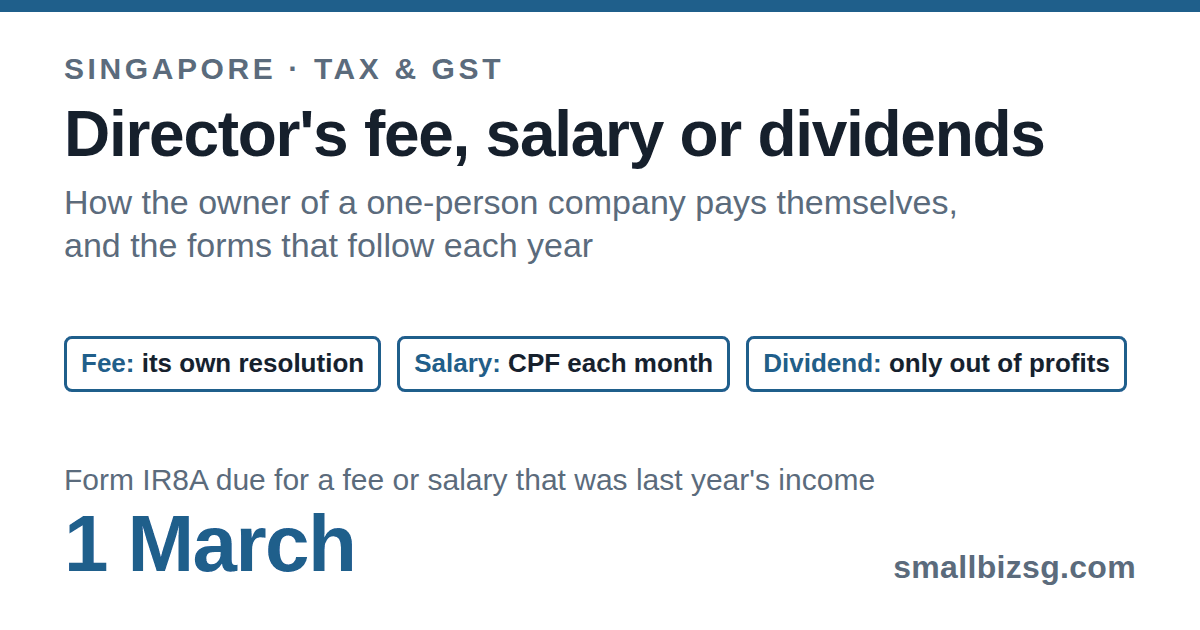
The owner of a one-person Singapore company can pay themselves a director’s fee, a salary or a dividend. A fee pays a director for the role, a salary pays an employee for their work, and a dividend is a share of the profits.
In this post, a one-person company is a private limited company whose only director is its only shareholder. The post also assumes the company uses the law’s standard rules for a private company, not rules of its own.
- A fee needs its own resolution, a formal decision on the fee alone (Companies Act, section 169). A sole shareholder can pass it by “recording the resolution and signing the record”.
- Fees and salaries are the owner’s income, and costs the company takes off its income before tax. The Inland Revenue Authority of Singapore (IRAS), the tax authority, counts a fee as income of the year the owner gains the right to it. That’s usually the year the fee is approved; a fee approved before the work is done becomes income as the work is done.
- The Central Provident Fund (CPF) is Singapore’s national savings scheme, and no CPF is due on a fee voted at a general meeting. CPF Board, a government body, gives that rule for directors’ fees “voted to them at General Meetings”, meetings of the shareholders. Its pages don’t say whether CPF is payable on a fee approved by a signed record.
- A salary is paid under a contract of service, an employment contract with the company, and can come on top of a fee. CPF is due on the salary by each month’s last day. With the CPF, employers also pay a levy for workforce training: 0.25% of the salary, at least S$2 and at most S$11.25 a month.
- CPF on a salary. From 1 January 2026, the rates are 17% and 20% for a Singapore citizen aged 55 or under earning more than S$750 a month. The same rates apply to a permanent resident of the same age and pay, from their third year as a permanent resident. The company pays both to CPF: its own 17% on top of the salary, and the owner’s 20%, which it may take from the salary.
- A dividend comes only “out of profits” (section 403). The owner decides it as director and as shareholder. Dividends from a Singapore resident company are generally not taxable, “as the tax paid by a company is final”.
- With no profits to pay from, there’s no dividend. A fee or a salary is a cost, so in a year without profits it adds to the company’s loss.
- Two yearly deadlines for a fee or a salary. Form IR8A, a statement of the owner’s fee or salary for the calendar year before, is due from the company by 1 March. By 18 April, the owner files their own tax return online, if they must file.
For dividends from investments, such as shares traded on a stock exchange, see IRAS’s Dividends page.
Later sections use one example company, with invented dates and figures: incorporated on 15 July 2024, with a financial year ending 30 June. Every rule links to its official page, and every page was read on 22 October 2026.
- How a fee, a salary and a dividend compare
- Why a sole proprietor can’t pay themselves this way
- A director’s fee: how it’s approved, and the year it’s taxed
- Whether a one-person company holds an AGM at all
- A salary: the contract, CPF and the monthly steps
- A dividend: only out of profits, and generally not taxed again
- When the company has no profits: what it can still pay
- What to file each year, and by when
How a fee, a salary and a dividend compare
The table compares the three ways on paperwork, tax, CPF and the Skills Development Levy (SDL), the training levy employers pay on a salary.
| What | Fee | Salary | Dividend |
|---|---|---|---|
| Paid to the owner as | Director | Employee | Shareholder, only out of profits |
| Paperwork | Its own resolution; Form IR8A each year | A contract of service; CPF each month; Form IR8A each year | Signed records, as director and as shareholder |
| Owner’s tax | Income, in the year they gain the right to it | Income | Generally not taxed |
| CPF and SDL | No CPF if voted at a general meeting; not stated for a signed record; no SDL | CPF from both sides; SDL 0.25% | Both are charged on wages, pay for employment; CPF Board’s pages linked here don’t mention dividends |
| Company’s tax | A cost it deducts | A cost it deducts, with the CPF and SDL | Comes out of profits after its tax |
- Paid as. A fee pays the owner for being a director and a salary for work “as an employee”; a dividend goes to shareholders, out of profits.
- Paperwork. A fee needs its own resolution, and a salary needs a contract of service and CPF each month. Both go on Form IR8A each year. Under the law’s standard rules for a private company, the owner recommends a dividend as director and declares it as shareholder, in signed records.
- Owner’s tax. IRAS taxes fees and salaries as employment income. Dividends from a Singapore resident company generally aren’t taxed, as the company’s tax is final.
- CPF and SDL. CPF is charged on wages, which the CPF Act defines as pay “due or granted to a person in respect of the person’s employment”. CPF is due on a salary, not on a fee voted at a general meeting; for fees in signed records, CPF Board’s pages don’t say. The SDL is 0.25% of a salary, at least S$2 and at most S$11.25 a month, and isn’t charged on directors’ fees.
- Company’s tax. Fees, salaries, the CPF the law requires and the SDL are on IRAS’s list of deductible costs. The company takes them off its income before its tax is worked out. A dividend comes out of profits after the company’s own tax.
Why a sole proprietor can’t pay themselves this way
The three ways need a company. IRAS counts a sole proprietor as self-employed, a group that “does not include director or shareholder of a private limited or limited company”. A sole proprietor declares the business’s profit in their own tax return, as self-employment income.
CPF Board says a sole proprietor “cannot receive CPF contributions from the firm as an employee”. Instead, a sole proprietor whose net trade income, the business’s yearly profit as IRAS works it out, is more than S$6,000 must pay MediSave contributions. MediSave is a CPF savings scheme for medical expenses (CPF Board), and this post doesn’t work out the amount.
A company’s director is different: under the Income Tax Act, “directors of companies are considered as ’employee’ for income tax purposes”, CPF Board says. Their fees are taxed as employment income. For CPF, the salary section says when a director counts as an employee.
Switching from a sole proprietorship to a company is the subject of the sole proprietorship vs company post.
A director’s fee: how it’s approved, and the year it’s taxed
A director’s fee needs a resolution of its own, which a one-person company can pass as a signed record. IRAS counts the fee as income of the year the director becomes entitled to it, the year they gain the right to it (IRAS).
The approval. A company can’t provide “emoluments”, a director’s pay and benefits for the role, unless a resolution approves them, says section 169 of the Companies Act. That resolution must be one “that is not related to other matters”. The Act’s list of emoluments includes fees, some expense allowances, pension contributions and benefits other than cash.
The Model Constitution, the law’s standard rules for a private company, has the company set directors’ pay “in general meeting” (regulation 74(1)). That’s a meeting of its members, meaning its shareholders, so they decide the amount. IRAS’s guide on director’s fees also says a fee “must be disclosed to and approved by members of the company”, citing section 169.
A company with only one member can pass the resolution by “recording the resolution and signing the record” (section 184G). So the owner signs it as the shareholder. Whether a one-person company holds an annual general meeting, the shareholders’ yearly meeting (AGM), at all is a separate rule, in the next section.
The year it’s taxed. IRAS treats a director’s fee “as income of the year in which you are entitled to the fee” (IRAS). It separates two cases:
- A fee approved after the year it pays for, which IRAS calls “approved in arrears”. The director is entitled to it, at the earliest, on “the date the fees are voted and approved at the company’s AGM”.
- A fee approved before the work is done, “approved in advance”. The director becomes entitled to it as they do the work.
For a fee approved after the year it pays for, the approval date, not that year, decides which year’s income it is.
In IRAS’s own example, a fee for the year ended 31 December 2024 was voted on 30 June 2025. It’s income for 2025, taxed in Year of Assessment (YA) 2026. That’s the year IRAS taxes an individual’s 2025 income.
Form IR8A’s notes ask for the “Date of approval of director’s fees at the company’s AGM/EGM”. An EGM, an extraordinary general meeting, is any general meeting other than the AGM.
A director who isn’t tax resident in Singapore is taxed at 24% on director’s fees, IRAS’s current rate for non-residents (IRAS). The company withholds that tax from the fee and pays it to IRAS (IRAS).
In the example company, the owner signs the resolution on 20 November 2026, approving a fee for the company’s year to 30 June 2026. Taking the signing day as the day of approval, the fee is the owner’s income for 2026, taxed in their YA 2027.
The IRAS pages linked here are silent on signed records, so taking the signing day as the approval day is this example’s assumption. Which day counts as the approval day is one of three questions listed at the end of this section.
The example company isn’t in the Auto-Inclusion Scheme (AIS), the system under which an employer sends its employees’ pay details to IRAS. So it gives the owner Form IR8A for 2026 by 1 March 2027. If the owner must file for YA 2027, they file online by 18 April 2027.
The company’s side. A director’s fee is a cost the company deducts. But IRAS’s guide allows the deduction only “when the company’s liability to pay such fees or bonuses actually arises”. That means when the company becomes legally bound to pay.
IRAS typically allows a fee approved after the year to be deducted for the year whose accounts record it as a cost. One of the guide’s conditions is that the fee is put to a vote at the AGM that approves those accounts. For a fee approved by a signed record, see the list at the end of this section.
CPF and the levy. CPF Board says CPF isn’t payable on directors’ fees “voted to them at General Meetings” (CPF Board). The SDL isn’t charged on directors’ fees at all (SDL FAQ).
What the pages leave open. For a fee approved by a signed record, the IRAS and CPF Board pages linked here don’t say:
- which day counts as the day of approval, the date Form IR8A asks for;
- which year the company deducts the fee in;
- whether CPF is payable on it.
These are questions for IRAS and CPF Board, and this post doesn’t guess at the answers. Both take written questions. IRAS takes them by secure email through its online portal, and CPF Board through the form on its “Write to us” page.
Whether a one-person company holds an AGM at all
It needn’t, if it sends out its financial statements, its yearly accounts, in time or resolves to do without AGMs.
A private company that sends out its financial statements within five months needs no AGM (Companies Act, section 175A). They go to all its members, and in a one-person company, the only member is the owner.
The Accounting and Corporate Regulatory Authority (ACRA), the government body that registers businesses, counts the five months from the year end.
If the statements go out later, an AGM is due within six months after the year ends (section 175), unless the third route below applies.
| Route | Deadline after the year end | For the example company |
|---|---|---|
| Send the financial statements to every member | Five months | By 30 November 2026 |
| Hold an AGM | Six months | By 30 December 2026 |
A third route is for every member to pass a resolution to do without AGMs (section 175A(1)(a)). What an AGM would deal with can then be done by written resolution, says ACRA. In a one-person company, the owner alone passes these resolutions, each as a signed record.
Whichever route it takes, the company declares its AGM details in its annual return, its yearly filing with ACRA. The example company’s annual return for that year is due by 30 January 2027. That’s seven months after its year end, ACRA’s deadline for a company whose shares aren’t listed on a stock exchange.
The company registration post’s calendar puts the annual return beside a company’s other first-year dates.
A salary: the contract, CPF and the monthly steps
When a director is also “engaged under a contract of service”, CPF is “payable on the wages received”, CPF Board says. Its guide to who needs CPF counts that director as an employee, “paid a salary on top of any fee received”. The company then pays CPF each month for an owner who is a Singapore citizen or permanent resident (CPF Board).
The example company pays its owner no salary, so this section imagines one: S$4,000 a month in 2026. Its owner here is a Singapore citizen aged 55 or under.
| Step | Amount |
|---|---|
| The salary for the month | S$4,000 |
| The company’s CPF share: 17% of S$4,000, paid on top of the salary | S$680 |
| The owner’s CPF share: 20% of S$4,000, taken out of the salary | S$800 |
| Paid to CPF for the owner: S$680 + S$800 | S$1,480 |
| Paid to the owner: S$4,000 − S$800, before their own income tax | S$3,200 |
| The SDL: 0.25% of S$4,000, paid with the CPF | S$10 |
| The company’s whole cost: S$4,000 + S$680 + S$10 | S$4,690 |
So a S$4,000 salary costs the company S$4,690 a month, and the owner is paid S$3,200 of it, before their own income tax. The rates and levels behind the table, all from CPF Board (rates; ceiling):
- From 1 January 2026, 17% from the company and 20% from the employee apply above S$750 a month. That’s for a citizen, or a permanent resident from their third year as a permanent resident, aged 55 or under. Other ages, and permanent residents in their first two years, have different rates.
- The company pays both shares, and may take the employee’s share out of that month’s salary (CPF Board).
- There’s no CPF on S$50 a month or less. At S$750 or less, other rates apply; above S$50 and up to S$500, there’s only the company’s share.
- In 2026, CPF is charged on up to S$8,000 of a month’s salary, and not on any amount above that. A yearly bonus has its own limit, and this post leaves bonuses out.
- The SDL is 0.25% of the month’s salary, at least S$2 and at most S$11.25 (CPF Board). The S$2 applies to a salary under S$800, and the S$11.25 to one over S$4,500. The company adds up the levy for all its employees and rounds the total down to the dollar.
So on S$4,000, both CPF rates apply to the whole salary, and neither SDL limit applies.
Before its first payment, the company needs a CPF Submission Number, the number an employer uses to pay CPF (CPF Board). Access to CPF Board’s online services is set up in Corppass, the system that controls who can act for a company on government digital services. This site’s post on Corppass roles explains who holds them.
Each month’s CPF is due by the month’s last day (CPF Board). CPF Board takes action against an employer that hasn’t paid by the 14th of the next month. That action includes interest of 1.5% a month, counted from the day after the due date, not from the 14th.
The SDL is charged on a director’s wages paid under an employment contract, but not on directors’ fees, the levy’s 2023 FAQ says (SDL FAQ). It’s paid with the CPF (CPF Board).
The salary, the CPF the law requires and the SDL are costs the company deducts. CPF paid above the required rates can’t be deducted (IRAS).
The Ministry of Manpower requires pay slips that list each item of pay for “employees covered by the Employment Act” (Ministry of Manpower). Its page on who that Act covers doesn’t mention company directors (Ministry of Manpower). So this post doesn’t say whether an owner must get pay slips.
A dividend: only out of profits, and generally not taxed again
A dividend is a share of the company’s profits paid to its shareholders, and it can only be paid “out of profits” (section 403(1)). In the owner’s hands, it’s generally not taxed again.
Deciding one. Under the Model Constitution, the shareholders declare a dividend, deciding that it’s paid, up to the amount the directors recommend (regulation 103). The directors can also pay dividends on their own, called interim dividends (regulation 104, in ACRA’s copy). They can do so when they judge the profits justify it.
In a one-person company, the owner makes both decisions on a declared dividend. As the only director, they sign the directors’ resolution (regulation 94). As the only shareholder, they sign the shareholders’ resolution (section 184G).
For an interim dividend, which the directors pay on their own, the owner signs only the directors’ resolution (regulation 94).
Only out of profits. Neither kind of dividend can be paid except out of profits (regulation 105). A director who wilfully, meaning on purpose, pays a dividend other than out of profits, or lets one be paid, commits an offence (section 403(2)). The penalty is a fine of up to S$5,000 or up to 12 months in jail.
That director can also be made to pay the company’s debts to its creditors, the people and businesses it owes money to. The most the director can be made to pay the creditors is the amount by which the dividends went over the profits.
Generally not taxed again. In Singapore, the tax a company pays on its profits is final, so its dividends are generally not taxable (IRAS). The rule is for a “Singapore resident company”. The corporate tax post explains when a company is tax resident, and how its profit is taxed.
CPF. CPF is charged on wages, pay for employment (CPF Act, section 2(1)), and none of the CPF Board pages linked in this post mentions dividends.
When the company has no profits: what it can still pay
With no profits to pay from, there’s no dividend, because a dividend comes only “out of profits” (section 403(1)). A company whose first year ends in a loss is one case. How a later year’s loss affects a dividend from profits kept from earlier years isn’t covered here.
That rule is about dividends. A fee still needs its own resolution (section 169), and a salary is paid under the contract of service (CPF Board).
Each is a cost the company deducts (IRAS), so in a year without profits it adds to the company’s loss. But costs from before the company’s business starts are on IRAS’s list of costs it can’t deduct.
IRAS lets a company carry an unused trade loss forward, to set against the income of later years (IRAS). The condition is “no substantial change in its shareholders and their shareholdings” at the dates IRAS checks, which it calls the shareholding test.
The owner is still taxed on the fee or the salary as their income (IRAS).
What to file each year, and by when
Form IR8A for a calendar year’s income is due by the next 1 March, for a fee or a salary alike (IRAS). For the example company, the post’s other dates fall between its year end, 30 June 2026, and 1 March 2027. Only the owner’s return, due by 18 April 2027, comes after, as the timeline below shows.
The year’s paperwork when the owner is paid
The example company’s year to 30 June 2026 and what follows it. Its dates are invented.
- 30 June 2026 Year end The company’s financial year ends
- 20 November 2026 Invented date The owner signs the resolution approving a director’s fee for that year
- By 30 November 2026 Deadline Financial statements to its member, or an AGM by 30 December 2026
- By 30 January 2027 Deadline The annual return, declaring the AGM details
- By 1 March 2027 Deadline Form IR8A for 2026, given to the owner
- By 18 April 2027 Deadline, if the owner must file The owner’s own return for YA 2027, for their 2026 income
If the company pays a salary (the example doesn’t; the salary section imagines one): CPF by the last day of each month, and the SDL paid with it.
Rules from the Companies Act and ACRA’s, IRAS’s and CPF Board’s pages, linked in the text. Read on 22 October 2026.
Form IR8A goes one of two ways (who must join the AIS; employers outside it):
| Route | Outside the AIS | In the AIS |
|---|---|---|
| Who | Fewer than five employees, counting directors; not registered for the AIS; not told by IRAS to join | Five or more employees, any employer IRAS tells to join, or any employer that registers |
| By 1 March | A paper Form IR8A to the owner | The pay details to IRAS |
| Then | The owner uses it to file; it needn’t go to IRAS | The pay details are pre-filled in the owner’s online tax return |
The example company has fewer than five employees, isn’t registered for the AIS, and hasn’t been told by IRAS to join. So it gives its owner a paper Form IR8A for 2026 by 1 March 2027.
The owner files their own return online by 18 April, if they must file. That’s generally when their total income in the year before was more than S$22,000 (who must file; filing by 18 April). The company’s own tax return is a separate filing, covered in the corporate tax post.
Accounting records must be kept for at least five years after the end of the financial year when the transactions or operations were completed (ACRA).
To make your own calendar, start from your company’s year end. The AGM section’s five and six months, and the annual return’s seven, count from it. Form IR8A’s 1 March and, if the owner must file, their own return’s 18 April stay fixed.
Where these facts came from
Every page below was read on 22 October 2026, and the Acts and regulations are quoted as they stood that day. The pages’ own dates run from 2 October 2023 to 19 October 2026. IRAS’s Form IR8A notes print none.
The example company’s dates, its 30 June year end and the imagined S$4,000 salary are invented. The dates and figures that follow from them use the rules in the rows below.
| What | Pages |
|---|---|
| A resolution of its own for a director’s pay, and what “emoluments” covers (section 169); one-member resolutions (section 184G); the AGM within six months (section 175); no AGM when the financial statements go out in time, or when every member resolves to do without (section 175A); dividends only out of profits, the S$5,000 fine, 12 months’ jail and the creditors (section 403) | Companies Act 1967: section 169, section 184G, section 175, section 175A, section 403 |
| Directors’ pay set in general meeting (regulation 74); extraordinary general meetings (regulation 47); one director’s resolution (regulation 94); declaring dividends (regulation 103); interim dividends (regulation 104); out of profits only (regulation 105) | Companies (Model Constitutions) Regulations 2015, First Schedule; ACRA’s copy of the Model Constitution (PDF, version in force from 9 December 2024) |
| What IRAS, CPF, CPF Board and ACRA are | IRAS: History and milestones (11 February 2026); CPF Board: Who we are (3 March 2026); ACRA: Overview of ACRA (10 April 2026) |
| Fees and salaries as employment income; the year a fee counts, usually the year it’s approved; fees approved in arrears and in advance; IRAS’s example, a fee for the year ended 31 December 2024 voted on 30 June 2025, income for 2025 and taxed in YA 2026 | IRAS: Employment Income (Salary, bonus, director’s fee) (7 August 2026) |
| A fee approved by members, under section 169; the company’s deduction once it’s bound to pay; a fee approved after the year, deducted for the year whose accounts record it, among other conditions if voted at the AGM that approves them | IRAS: Tax Treatment of Director’s Fees and Bonuses from Employment (PDF; fourth edition, 30 January 2026); Explanatory notes for completion of Form IR8A & Appendix 8A (PDF, for the year ended 31 December 2025), for the date of approval |
| Directors’ fees, salaries, the CPF the law requires and the SDL as deductible costs, taken off income before tax; CPF above the required rates, and costs from before the business starts, not | IRAS: Business Expenses (16 October 2026) |
| The AIS compulsory from five employees, directors counted, or on IRAS’s notice; Form IR8A by 1 March of the year after the income; employers outside the AIS give it to employees and need not submit it; AIS details pre-filled in employees’ returns | IRAS: Join the AIS, Reporting Employee Earnings (both 10 August 2026) |
| Dividends from a Singapore resident company not taxable, as the company’s tax is final | IRAS: Dividends (27 February 2026) |
| 24%, IRAS’s current rate for non-residents, director’s fees included | IRAS: Individual Income Tax rates (27 April 2026) |
| The company withholding the 24% from a non-resident director’s fees; how a board director’s tax residence is decided | IRAS: Tax obligations for non-resident director (14 August 2026), Board director (11 August 2026) |
| Sole proprietors as self-employed, declaring their self-employment income in their own return; directors and shareholders not | IRAS: Am I a self-employed individual? (31 August 2026) |
| Filing a return above S$22,000 of income in the calendar year before; income assessed on a preceding calendar year basis, so YA 2026 for 2025’s income and YA 2027 for 2026’s; filing online by 18 April | IRAS: Individuals required to file tax (15 October 2026), e-Filing your Income Tax Return (27 February 2026) |
| A trade loss carried forward, subject to the shareholding test | IRAS: Unutilised Items (14 August 2026) |
| Directors as “employee” for income tax; no CPF on fees voted at general meetings; CPF on the wages of a director engaged under a contract of service; a salary on top of a fee | CPF Board: Are directors who receive director fees covered under Contribute As You Earn (CAYE)? (20 June 2024), Are CPF contributions payable for directors? (7 June 2024), Who do you need to pay CPF for? (PDF, 28 July 2025) |
| CPF charged on wages; citizens and permanent residents; 17% and 20% from 1 January 2026 above S$750 a month, for a citizen or a permanent resident from their third year as a permanent resident, aged 55 or under; other rates for other ages, for permanent residents’ first two years and for other wage bands; the S$50 and S$500 levels, and the company’s own share up to S$500; the employee’s share taken from that month’s salary; the S$8,000 limit on a month’s salary in 2026 (the Ordinary Wage ceiling), and a bonus’s own limit | CPF Board: How much CPF contributions to pay (19 October 2026), How do I recover the employee’s share of CPF contributions? (2 July 2024), What is the Ordinary Wage (OW) ceiling? (14 August 2026), What are Ordinary Wages (OW) and Additional Wages (AW)? (13 August 2026) |
| The CPF Submission Number and Corppass; the month’s last day, the 14th and 1.5% a month | CPF Board: Applying for a CPF Submission Number (1 August 2025), When is the due date for CPF contributions? (25 June 2024) |
| A sole proprietor and CPF; MediSave above S$6,000 of net trade income; what MediSave is | CPF Board: Are CPF contributions payable for partner or sole proprietor of a firm? (20 June 2024), What is MediSave? (7 September 2025) |
| “Wages” | Central Provident Fund Act 1953, section 2(1) |
| The SDL at 0.25%, at least S$2 (on a salary under S$800) and at most S$11.25 (on one over S$4,500) a month, the total rounded down to the dollar, paid with the CPF, for workforce training; wages, pay for employment, as the SDL Act defines them; no SDL on directors’ fees; charged on a director’s wages under an employment contract | CPF Board: Skills Development Levy (2 July 2026); the Generic SDL FAQ (PDF, 2 October 2023) |
| Pay slips that list each item of pay; who the Employment Act covers | Ministry of Manpower: Itemised pay slips (14 March 2024), Employment Act: who it covers (24 July 2025) |
| AGM deadlines; the five months, counted from the year end; doing without AGMs and written resolutions; the annual return’s AGM details | ACRA: Due dates & requirements for annual general meetings (AGMs) (11 February 2026) |
| The annual return within seven months after the year end, for a company whose shares aren’t listed | ACRA: Deadline & requirements for annual returns (14 May 2026) |
| Asking IRAS and CPF Board in writing | IRAS: Individual Income Tax Enquiries (21 August 2026); CPF Board: Write to us (10 January 2025) |
| Accounting records kept for at least five years | ACRA: Company directors’ duties & key obligations (3 February 2026) |
Rules and pages change. If something here has gone out of date, tell me and I’ll correct it and note when it was corrected.
What this post is not
I’m not a lawyer, an accountant or a tax agent, and nothing here is advice about your company’s situation. It sets out the rules for each way an owner can be paid, as the law and the agencies state them. It doesn’t say which way to choose.
It’s written for a private limited company whose only director is its only shareholder, and which follows the Model Constitution. It leaves out loans between the owner and the company, expense claims, bonuses, and how a later year’s loss affects a dividend from earlier profits. It doesn’t work out the owner’s own income tax, which depends on their reliefs; IRAS’s rates page has the rates.
Non-resident owners get only a short note, and a company with other staff isn’t covered. Whether a director charges goods and services tax on a fee is answered in this site’s post on registering for that tax.
This post rests on published sources alone, and it was drafted with AI assistance and checked by me against them. No link here is an affiliate link, the kind where a seller pays the site a fee if a reader buys something through it. Nobody paid for a mention, and the page on how this site is paid for says the rest.