The short version
Corporate tax in Singapore is 17% of a company’s profit, counted after the costs the tax rules allow. This profit can differ from the profit in its accounts. The tax is paid to the Inland Revenue Authority of Singapore (IRAS), the government’s tax authority.
A new company pays much less in its first three tax years, if it meets the conditions further down. On IRAS’s notices, each tax year is a Year of Assessment (YA). That is the calendar year after the financial year ends: profit for a year ending in 2025 is taxed in YA 2026.
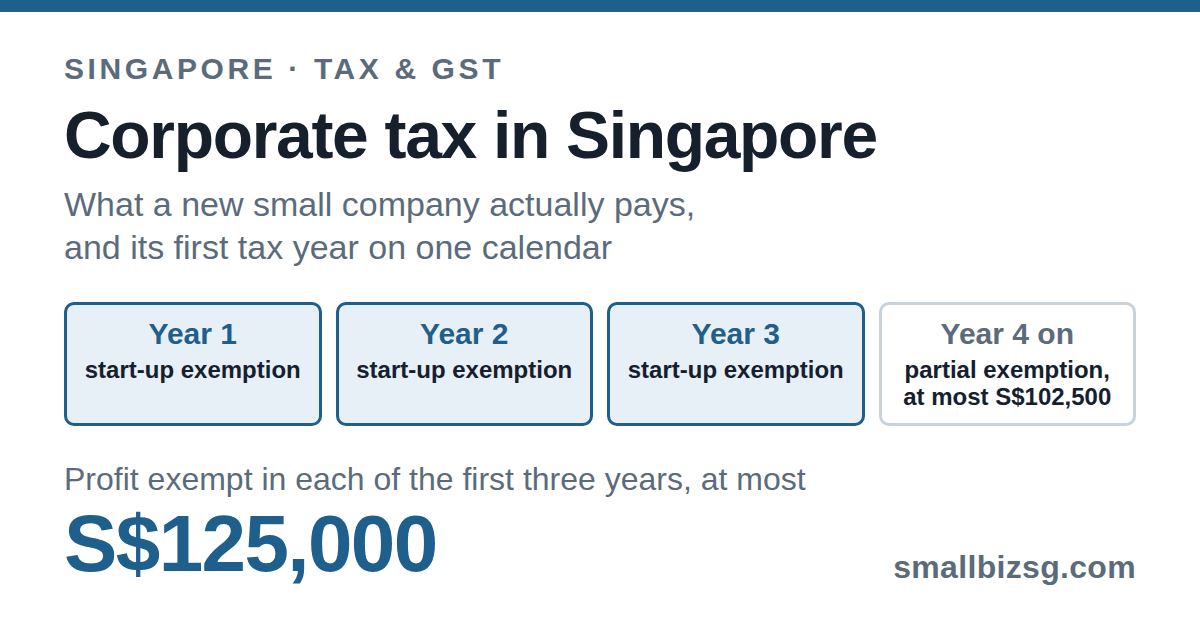
In each of those first three tax years, part of that year’s profit is not taxed:
- 75% of the part of the profit up to S$100,000;
- 50% of the part of the profit between S$100,000 and S$200,000.
The part of the profit above S$200,000 is taxed in full at 17%.
Here is the calculation for S$50,000 of profit in one of those years:
| Step | Amount |
|---|---|
| Profit, after the costs the tax rules allow | S$50,000 |
| Not taxed: 75% of S$50,000 | S$37,500 |
| Taxed: S$50,000 − S$37,500 | S$12,500 |
| Tax: 17% of S$12,500 | S$2,125 |
So, before any rebate (a reduction IRAS makes to the tax, explained below), the company pays S$2,125, about 4% of its profit.
The whole post follows one example company: a one-person private limited company (Pte Ltd), set up (incorporated) on 15 July 2024. The example company’s financial year, the year its accounts cover, ends on 30 June.
Its director is its only shareholder and does all the work. Its dates and figures are invented; the rules are IRAS’s, each linked to its page and read on 15 October 2026.
For the example company, YA 2026 is its first tax year, because its first financial year ended on 30 June 2025.
The rebate is granted one YA at a time. For YA 2026 it is 50% of the tax, for every company that pays tax, and IRAS takes it off automatically.
On S$50,000 of profit, the example company pays S$1,062.50 for YA 2026 (50% of S$2,125). For each of the next two YAs, YA 2027 and YA 2028, it pays S$2,125, unless a rebate is granted for those years too.
A company set up in 2026 or later has no YA 2026, so it doesn’t get this rebate. A company set up in 2025 doesn’t get it either, if its first financial year ends in 2026 and lasts 12 months or less. That company’s first tax year is YA 2027.
A company with a local employee may get a cash grant in place of some or all of its rebate, as explained below.
Each year the company files an estimate of its profit with IRAS, unless it can skip it, and its tax return, which reports its profit. The example company files its estimate by 30 September, three months after its year end, and its return by 30 November of the following year.
The example company pays each bill, which IRAS calls a Notice of Assessment, within one month of its date.
This is information from IRAS’s pages, not advice about your own company’s numbers. It was written with AI assistance and checked by me.
- What the tax is charged on, and which year it belongs to
- The example company’s first three years, with dates
- What a new small company actually pays
- The three start-up years run whether or not you make a profit
- The ECI: an estimate three months after the year end, or nothing
- The return: Form C-S (Lite), Form C-S, Form C, or the dormant form
- Paying, and what lateness costs
- How it went for me
What the tax is charged on, and which year it belongs to
The tax is charged on profit, not on sales. IRAS’s basic guide says it is charged on income after the costs the tax rules allow: what IRAS calls chargeable income. In this post, “profit” means chargeable income.
Say a company has S$120,000 of sales and spends S$90,000 running the business, all on costs the tax rules allow. Its chargeable income is S$30,000 (S$120,000 − S$90,000).
The tax rules decide which costs count, and this post doesn’t list them. For your own costs, ask a qualified accountant or tax agent (someone paid to do tax filings).
The basic guide says the company chooses its own financial year end; IRAS doesn’t set it.
A company is a Singapore tax resident when it is controlled and managed here: usually, where its directors meet to make its main decisions. IRAS also looks at where the directors are based. Only a tax resident gets the start-up tax break below, which leaves part of its profit untaxed.
The example company’s first three years, with dates
Two rules decide when IRAS’s two filing notices arrive; both are reminders to file, not bills. The first rule is about the notice for the estimate of the year’s profit, which IRAS calls Estimated Chargeable Income (ECI).
The ECI page says the notice comes in the last month of each financial year, and the deadline still applies even if no notice comes. The basic guide adds that the first ECI notice comes in the year after the company is incorporated.
The second rule is about the notice for the tax return, which comes by May each year. The first return notice comes in the second year after the year of incorporation: for the example company, by May 2026.
The return is one of three forms, which IRAS calls Form C-S (Lite), Form C-S and Form C. A company with no business and no income all year, which IRAS calls dormant, can file a short form instead.
For the example company, the rules give the calendar below.
The example company’s first tax year: incorporated 15 July 2024, year end 30 June.
- 15 July 2024Incorporated; first financial year runs to 30 June 2025
- June 2025First financial year ends; IRAS’s ECI notice arrives this month
- By 30 September 2025File the ECI, or nothing if revenue is S$5 million or less and the estimated profit is zero
- Late 2025, if an estimate above zero was filedPay within one month of the Notice of Assessment, or in monthly instalments by GIRO (an automatic bank deduction); the YA 2026 rebate comes off later, when IRAS reassesses the bill by June 2026
- By May 2026The first return notice arrives
- By 30 September 2026The second year’s ECI, two months before the first year’s return
- 30 November 2026File the return: Form C-S (Lite), Form C-S, Form C or the dormant form
- After the return is filedPay any tax still owed within one month of the Notice of Assessment on it; tax overpaid on the estimate is refunded
Every year after: the ECI by 30 September, the return by 30 November. YA 2026, YA 2027 and YA 2028 are the start-up years, when part of the profit is not taxed. From YA 2029 a smaller tax break, the partial exemption, takes over.
Deadlines from IRAS’s basic guide and ECI page, linked in the text; the dates are the example company’s. Checked on 15 October 2026.
Two things on the calendar are easy to miss. First, a company whose estimated profit is above zero gets its first bill from that estimate, not from its return.
A company that files an ECI above zero gets a Notice of Assessment on it. It pays within one month, or in monthly instalments if it filed early enough and pays by GIRO, an automatic deduction from its bank account.
Second, from the second year the deadlines overlap. By 30 September 2026 the example company files its second ECI, two months before its first return is due on 30 November 2026.
The registration post has the rest of the first-year calendar. That includes what the Accounting and Corporate Regulatory Authority (ACRA), the government body that registers companies, asks for.
If your company’s first financial year ends in the calendar year it was set up, that first period still counts as a whole tax year. It also uses up one of the three start-up years.
No notice comes for that first year, but the ECI rules still apply. If the company started business or received any income that year, it must still file a return. It asks IRAS for the form by filling out the “Request for Income Tax Return for Newly Incorporated Companies”.
A first financial year over 12 months still uses up start-up years: its profit is split between two tax years, and both count. The basic guide explains both cases, with their dates.
What a new small company actually pays
Less than 17% of its profit, for three years. In each of a new company’s first three tax years, 75% of its chargeable income up to S$100,000 is exempt, which means it isn’t taxed. So is 50% of the part between S$100,000 and S$200,000.
At most S$125,000 of a year’s profit is tax-free (S$75,000 + S$50,000), once the profit reaches S$200,000. That is a tax saving of up to S$21,250 (17% of S$125,000).
What the example company would pay in a start-up year, before any rebate:
| Chargeable income | Not taxed (start-up exemption) | Taxed | Tax: 17% of the taxed part |
|---|---|---|---|
| S$30,000 | S$22,500: 75% of S$30,000 | S$7,500 | S$1,275 |
| S$50,000 | S$37,500: 75% of S$50,000 | S$12,500 | S$2,125 |
| S$150,000 | S$100,000 in all: S$75,000 (75% of the profit up to S$100,000) plus S$25,000 (50% of the S$50,000 above it) | S$50,000 | S$8,500 |
IRAS’s rates page says the company claims the exemption by completing the exemption’s sections of the ECI and of the return.
IRAS takes the YA 2026 rebate off when it works out the tax, so the ECI and the return are filed without it. For a company without the cash grant, the YA 2026 rebate halves the tax column above. That gives S$637.50 (50% of S$1,275), S$1,062.50 (50% of S$2,125) and S$4,250 (50% of S$8,500).
A company gets a S$2,000 cash grant if it paid Central Provident Fund (CPF) contributions for a local employee in calendar year 2025. CPF is Singapore’s national savings scheme; a local employee is a Singapore citizen or permanent resident.
The company must also still be in business when the grant is paid. A shareholder who is also a director doesn’t count as a local employee, even when the company pays CPF for them. So the example company gets no grant.
The grant replaces S$2,000 of the rebate: a company with the grant gets only the part of its rebate above S$2,000. With S$2,125 of tax, the rebate would be S$1,062.50, so a company with the grant gets no rebate. It pays the full S$2,125 in tax and receives the S$2,000 grant automatically, by the second quarter of 2026.
The rebate and the grant together can’t be more than S$40,000 for one company for YA 2026.
From the fourth tax year, the company gets the partial tax exemption: a smaller tax break open to every company. It makes 75% of the profit up to S$10,000 tax-free, and 50% of the part between S$10,000 and S$200,000. That is at most S$102,500 a year.
On S$50,000 of profit, the example company would pay S$3,825 a year from YA 2029, before any rebate:
| Step | Amount |
|---|---|
| Not taxed: 75% of S$10,000 | S$7,500 |
| Not taxed: 50% of the S$40,000 above S$10,000 | S$20,000 |
| Taxed: S$50,000 − S$7,500 − S$20,000 | S$22,500 |
| Tax: 17% of S$22,500 | S$3,825 |
The three start-up years run whether or not you make a profit
IRAS’s rates page says the exemption covers only the first three tax years in a row. A year with a loss or no income still counts as one of the three.
A loss in YA 2026 and a small profit in YA 2027 would leave the example company only YA 2028 to use in full. Unused exemption is lost: none carries forward to a later year. A loss is different: an earlier year’s loss comes off this year’s profit first, and the exemption applies to what is left.
A year without profit can cost money later. Say the example company has no profit in YA 2026, then S$50,000 in each of the next three years.
Its third profitable year, YA 2029, falls outside the start-up years. It pays S$3,825 of tax that year instead of a start-up year’s S$2,125: S$1,700 more, before any rebate.
Who can use the start-up exemption
The rates page sets these conditions for each tax year. The company must meet all four. It must:
- be incorporated in Singapore;
- be a tax resident that year;
- have no more than 20 shareholders for the whole financial year;
- have only people as shareholders, or at least one person holding 10% or more of its ordinary shares (its normal shares).
Companies whose main business is holding investments, and property developers, can’t use the start-up exemption; they get the partial tax exemption instead. When a sole proprietor or partners move their business into a company, the company gets its own three years if it meets all the conditions. IRAS calls this converting the business.
The ECI: an estimate three months after the year end, or nothing
IRAS’s ECI page says the ECI is due within three months after the financial year ends: for the example company, by 30 September 2025. The company declares the profit before the start-up exemption and says whether it qualifies; IRAS works out the exemption itself.
Some companies don’t have to file an ECI at all. IRAS calls this the ECI filing waiver: such a company simply doesn’t file, and there is nothing to apply for.
Both must be true: revenue of S$5 million or less for the financial year, and an estimated profit of zero, which IRAS calls nil. A loss for tax purposes counts as nil: the rates page says a company with losses has nil chargeable income. Revenue here means income from the company’s main business, not bank interest or other separate income.
The company checks this itself; it doesn’t need to tell IRAS. IRAS’s notice still arrives, and myTax Portal, the website where companies file with IRAS, may still show “Ready to File”.
A company registered in Singapore that pays by GIRO can pay the tax on its ECI in monthly instalments:
| ECI filed by the 26th of | Monthly instalments, at most | For the example company (30 June year end) |
|---|---|---|
| The first month after the year end | 10 | By 26 July |
| The second month after it | 8 | By 26 August |
| The third month after it | 6 | By 26 September |
| Later | None | From 27 September (still on time until 30 September) |
A company without GIRO for corporate tax signs up at least three weeks before filing the ECI, on myTax Portal or through internet banking. If the GIRO arrangement isn’t approved before the payment is due, the company pays the full amount within one month of the Notice of Assessment.
If the three months have passed, a late ECI is still accepted until IRAS sends that year’s Notice of Assessment. Its tax can’t then be paid in instalments.
A company that should file and doesn’t may get a Notice of Assessment based on IRAS’s own estimate. The tax on it is due within one month.
If the company disagrees, it files an objection, a formal request to change the bill. It has two months from the notice’s date, and gives its own estimate and the reason its ECI wasn’t filed on time.
The person filing needs the right role in Corppass first. Corppass is the system a company uses to give people access to its government online services.
The ECI page says the filer must be an “Approver” for IRAS’s “Corporate Tax (Filing and Applications)” service. A “Preparer” can enter figures but can’t file.
The company’s Corppass administrator gives the role, and if that is you, you give it to yourself. If you pay a firm to file for you, the registration post covers the access it needs.
To give yourself the role, sign in to Corppass as the company’s administrator. The route, as its screens showed it to me:
- Open e-Service Access.
- Choose Select Entity’s e-Services (entity means the company) and add Corporate Tax (Filing and Applications).
- Assign it to yourself as the user, with the role Approver.
- Put a start date on every row, which Corppass calls the authorisation effective date. A message that a highlighted e-service “requires valid inputs” means a row has no date.
- Submit, then check the role under View Entity’s e-Service Access.
The return: Form C-S (Lite), Form C-S, Form C, or the dormant form
One return a year, by 30 November: one of the three forms IRAS’s overview lists, or the dormant form. A company with no business and no income all year may use the dormant form, a short version of the return. The overview says every company that isn’t dormant files one of the three, even with no income or a loss.
IRAS’s filing guidance fixes the date at 30 November, always at least 11 months after the financial year ends. The filer needs the same Corppass Approver role as for the ECI.
Claiming the start-up exemption doesn’t stop a company using Form C-S or Form C-S (Lite). The rates page says it is claimed on whichever of the three forms the company files.
| Form | Who may use it | What it asks | What is sent with it |
|---|---|---|---|
| Form C-S (Lite) | Revenue of S$200,000 or less, and Form C-S’s conditions in the next row | Six essential fields to fill in | Nothing: the company still prepares its accounts (the yearly financial statements) and its tax computation (how the tax was worked out). It sends them only if IRAS asks |
| Form C-S | A company incorporated in Singapore, with revenue of S$5 million or less. All its income is taxable at 17%, so none is taxed at a lower rate or tax exempt, as under a tax incentive. The overview makes two exceptions: some tax exempt Singapore dividends and some foreign income exempt by law. Claiming the start-up exemption is still allowed, as the paragraph above says. The company makes none of the four special claims the overview lists. These are “Carry-back of Current Year Capital Allowances/ Losses”, “Group Relief”, “Investment Allowance” and “Foreign Tax Credit and Tax Deducted at Source” | 18 fields | The same: prepared, not sent |
| Form C | Any company; it must use Form C if it can’t use the others | More fields than Form C-S | The accounts, a detailed profit and loss statement (the year’s income and costs), the tax computation and other supporting documents |
| Form for Dormant Company | No business and no income for the whole financial year | Two essential fields | Nothing: the dormant companies page says the accounts are not sent |
If the company did no business all year
The dormant form is the shortest: two essential fields, about five minutes. Even interest on a fixed deposit makes a company not dormant: it files one of the three forms. Expenses from a dormant year can’t be claimed in that year’s return, the dormant companies page adds, as the company wasn’t carrying on a business.
ACRA’s test is different. On its financial statements page, “dormant” means no significant accounting transactions. So a company can file the dormant form with IRAS and still owe ACRA financial statements, as the registration post explains.
IRAS’s dormant companies page says a dormant company files a return every year unless it is granted the waiver from filing. That is not the ECI filing waiver: it is applied for, and it stops the return as well.
| What differs | Filing the dormant form | Applying for the waiver from filing (not the ECI filing waiver) |
|---|---|---|
| Who it is for | A company with no business and no income for the whole financial year | A dormant company that doesn’t plan to restart in the next two years. It has no investments that produce income. It has cancelled any registration for goods and services tax (a tax charged on sales by businesses registered for it). It has filed every return it can, up to the date business stopped |
| The myTax Portal service | “File Form for Dormant Company” | “Apply for Waiver/ File last Form C-S/ C (Dormant/ Striking Off)”, which also serves companies being closed (struck off) |
| First step | The Corppass Approver role, as for any return | An application, made with Corppass access to Corporate Tax (Filing and Applications). IRAS answers within two months, or longer if the case is complex. Some returns up to the date business stopped, such as the one for the last part of a year, aren’t open for filing yet. Applying lets the company file them through the “File Form C-S/ Form C-S (Lite)/ Form C” service. It must file them within 21 days of applying, or the application is rejected |
| What it files | The dormant form every year, by 30 November. No ECI: a year with no income meets both conditions for skipping the ECI, so there is nothing to file or tell IRAS | Nothing once the waiver from filing is granted: no return and no ECI |
| Its status in myTax Portal, under “Update Corporate Profile” (IRAS’s filing season page) | “Active” | “No Business Done”, once the waiver from filing is granted |
| If business restarts | It files one of the three forms for that year | It tells IRAS within one month of restarting or receiving any income |
Paying, and what lateness costs
Tax is due within one month from the date on the Notice of Assessment. IRAS’s late payment page says the tax is still due then, even if the company has filed an objection.
No bill comes for a zero ECI. If the return shows less profit than the estimate, the extra tax already paid is refunded automatically.
IRAS calls the amount to be refunded a tax credit. The filing season page says it is refunded “within 30 days from the date the credit arose”. A company that pays tax by GIRO from its own bank account gets the refund in that account.
Late payment costs 5%, and more if the tax stays unpaid. IRAS’s example is a S$10,000 bill paid late: a 5% penalty of S$500 (5% of S$10,000).
If the tax is still unpaid 60 days after the 5% penalty, 1% more may be added for every full month. These monthly additions stop at 12% of the unpaid tax, on top of the 5%. On IRAS’s S$10,000 bill, that is S$1,700 at most in all (S$500 + S$1,200).
Paying by GIRO avoids the late payment penalty only if the GIRO arrangement is approved before the due date. A company that has difficulty paying may apply for a longer payment plan through myTax Portal’s “Apply/Manage GIRO Plan” service.
IRAS’s late filing page lists what it may do if the return isn’t filed by 30 November:
- A bill based on IRAS’s own estimate, payable within one month.
- An offer to let the company pay instead of being taken to court, if it also files the overdue return by a set date. IRAS calls this payment a composition amount: up to S$5,000 for each offence.
- A notice to the director, asking for the return’s information by a set date.
- A summons: an order to attend court.
Whatever IRAS does, the overdue return still has to be filed.
In court, a company can be fined up to S$5,000 for each offence. For two years or more of unfiled returns, it can also be ordered to pay twice the tax IRAS has worked out. A director found guilty of ignoring the notice in step 3 can be fined up to S$10,000, jailed for up to 12 months, or both.
The filing season page says the director stays responsible for filing on time and correctly, even when the company has hired a tax agent.
Is an agent needed at all? The basic guide answers in one line: “It is not a requirement.”
Keep records, from receipts and invoices to bank statements, for at least five years from the YA they belong to. Poor records can bring penalties of up to S$5,000, and IRAS may estimate the revenue itself.
How it went for me
The notices arrived as the pages say they do. My company’s first ECI notice arrived in the last month of its first financial year.
The notice for the return came the next year, with 30 November on it. The next ECI notice came after it, a year after the first.
My company met both of the ECI filing waiver’s conditions, so it had no ECI to file and nothing to send IRAS. The portal still showed “Ready to File” for that ECI; IRAS’s page says it may.
I filed my company’s return myself on myTax Portal, after the Corppass step above. Whoever files needs the Approver role for Corporate Tax (Filing and Applications) in Corppass, or myTax Portal won’t let them file.
IRAS’s filing reminder to my company said three things worth repeating:
- file on time even if the company did no business or made a loss;
- the dormant form has two fields;
- the director stays responsible even with a tax agent.
Count the three start-up years from the first tax year, as the calendar above does, not from the first profitable year.
Where these facts came from
Every page below was opened on 15 October 2026, with every section expanded. The oldest of the pages’ own “Last updated” dates is 23 June 2025, and the newest 8 October 2026.
The Corppass route is as its screens showed it when I set up my own company’s access. Apart from the invented example company and “How it went for me”, everything else is from IRAS’s, ACRA’s and the CPF Board’s own pages. The worked tables, the halved YA 2026 figures and the S$21,250, S$1,700, S$1,200 and 4% figures are arithmetic on IRAS’s rates and examples, shown above.
| What | Pages |
|---|---|
| The 17% rate; the start-up exemption (75% of profit up to S$100,000, 50% of profit between S$100,000 and S$200,000, at most S$125,000, the first three years of assessment, consecutive, so YA 2026, YA 2027 and YA 2028 for the example company, a year with a loss or no income counted, nil chargeable income for a company with losses, profit above S$200,000 taxed in full, the conditions (incorporated in Singapore, tax resident that year, 20 shareholders, 10%), the exclusions, losses set off first, no carry-forward, a business converted into a company, the claim on the ECI and on whichever form is filed); the partial exemption (75% of profit up to S$10,000, 50% of profit between S$10,000 and S$200,000, at most S$102,500, from the fourth year of assessment, so YA 2029 for the example company); the YA 2026 rebate (50% of the tax, granted for YA 2026 to every company that pays tax, computed by IRAS in the assessment and not in the ECI or the return, the S$2,000 grant in place of S$2,000 of rebate, received automatically by the second quarter of 2026, the S$40,000 cap for YA 2026, the conditions of being in business and of a local employee in calendar year 2025, shareholders who are also directors not counted; its table of rebates by year of assessment, to YA 2026) | IRAS — Corporate Income Tax Rate, Rebates & Tax Exemption Schemes (7 August 2026) |
| Chargeable income; which year of assessment a year’s profit belongs to; the year end chosen by the company; the 12-month limit and the split of a longer first period between two years of assessment; for a first year ending in the year of incorporation, no notice, the ECI rules still applying, and the return due if the company started business or received any income, asked for with a request form; the ECI notice from the year after incorporation and the return notice by May from the second year after the year of incorporation, each a reminder to file; the example company’s dates that follow (year end 30 June, first accounts under 12 months, ECI by 30 September, first year of assessment YA 2026); a first financial year ending in the year of incorporation counted as a whole year of assessment; “It is not a requirement.” | IRAS — Basic Guide to Corporate Income Tax for Companies (7 August 2026) |
| Tax residency by control and management, usually where the board meets to make strategic decisions, with where the directors are based among the facts IRAS looks at; the start-up exemption as a resident’s benefit | IRAS — Tax Residency of a Company / Certificate of Residence (23 June 2025) |
| The ECI: three months, the waiver (S$5 million of revenue, the income from the company’s main business; a nil ECI; nothing to apply for or tell IRAS), “Ready to File”, the deadline with no notice, a late ECI accepted until the Notice of Assessment but without instalments, the estimated assessment and the two months from its date to object, the GIRO instalments (10, 8, 6, 0, counted in months from the financial year end and filed by the 26th, so 26 July, 26 August and 26 September after a 30 June year end, and none from 27 September) and the three-week sign-up, the Approver and Preparer roles, the notice in the last month of the financial year, no Notice of Assessment for a zero ECI, the refund after the return, an objection with reasons and a revised estimate, the exemption worked out by IRAS on the ECI | IRAS — Estimated Chargeable Income (ECI) Filing (10 August 2026) |
| The three forms: incorporation in Singapore, the S$5 million and S$200,000 thresholds, the 17% and special-claims conditions, the meaning of the 17% condition (no income tax exempt or at a concessionary rate under a tax incentive), the four special claims by name, the accounts and tax computation prepared and sent on request, six fields against 18, what is prepared and what is attached; the 30 November date and the 11 months; the Approver role for the return | IRAS — Overview of Form C-S / Form C-S (Lite) / Form C (11 August 2026), Guidance on Filing (10 August 2026) |
| The YA 2026 season: the four forms in one list, a dormant company’s two statuses (“Active”, and “No Business Done” once the waiver from filing is granted), directors’ responsibility, refunds within 30 days of the credit arising, to the company’s own bank account when it pays by GIRO | IRAS — Corporate Income Tax Filing Season 2026 (30 September 2026) |
| Dormant companies: the definition, the two-field form and its five minutes, its service name and the Corppass step, no financial statements to IRAS, the fixed-deposit example, a dormant year’s expenses not claimable in its return; the waiver from filing (its conditions, its service name, within two months or longer if the case is complex, the “File Form C-S/ Form C-S (Lite)/ Form C” service for returns not yet open for filing, the rejection of the application if those returns aren’t filed within 21 days of applying, no ECI once granted, the one month to report a restart) | IRAS — Dormant Companies (7 August 2026) |
| Late or non-filing: the estimated assessment, composition of up to S$5,000 in place of prosecution, with the overdue return filed by a set date, the notice to the director, the summons, the S$5,000 and S$10,000 fines and up to 12 months’ jail, twice the tax for two years or more, all on conviction; the return still to be filed | IRAS — Late Filing or Non-Filing of Corporate Income Tax Returns (10 August 2026) |
| Paying within one month, even after an objection; the 5% penalty, the 1% a month after 60 days up to 12% of the unpaid tax, the S$10,000 example, so S$1,700 at most in all on it; GIRO approval before the due date; GIRO sign-up on myTax Portal or by internet banking; a longer payment plan for a company with difficulty paying | IRAS — Late Payment or Non-Payment of Corporate Income Tax (10 August 2026) |
| Records, receipts and invoices among them, kept at least five years from the year of assessment; penalties of up to S$5,000; IRAS’s own estimate of revenue | IRAS — Record Keeping Requirements (22 January 2026) |
| Corppass: what it is for; the application for the waiver from filing, made with access to Corporate Tax (Filing and Applications) | IRAS — Corppass (24 August 2026) |
| IRAS, the government’s tax authority; goods and services tax, which registered businesses charge on their sales | IRAS — History and milestones (11 February 2026), Goods and Services Tax (GST): What It Is and How It Works (8 October 2026) |
| ACRA, the government body that registers companies | ACRA — Overview of ACRA (10 April 2026) |
| CPF, Singapore’s national savings scheme | CPF Board — Who we are (3 March 2026) |
| ACRA’s meaning of dormant: no significant accounting transactions | ACRA — Financial statements: requirements and exemptions (24 September 2026) |
Rates, rebates and dates change, and the rebate is granted one YA at a time. If something here has gone out of date, tell me and I’ll correct it and note when it was corrected.
What this post is not
I’m not an accountant, a tax agent or a lawyer, and nothing here is advice about your company’s numbers. It is what IRAS’s own pages say, arranged around one example company, with my own experience alongside.
How a loss carries over, and what your chargeable income is, depend on your company’s own records. For those, and anything else beyond the example, ask a qualified accountant or tax agent.
It leaves out goods and services tax, which has its own post. It also leaves out tax on payments to non-residents, and how a director’s own pay and dividends, profit paid out to shareholders, are taxed.
The registration post covers setting up the company and ACRA’s first-year calendar; the sole proprietorship vs Pte Ltd post compares the two.
This post was written with AI assistance and checked by me against the sources above. No link here is an affiliate link, one that pays this site. Nobody paid for a mention; how this site is paid for says the rest.