In 2024 I registered a business in Singapore, and picked the wrong structure.
The short version
- A sole proprietorship is a business with one owner, and in law it is not separate from that owner. A private limited company (Pte Ltd) is a separate legal entity, owned by its shareholders.
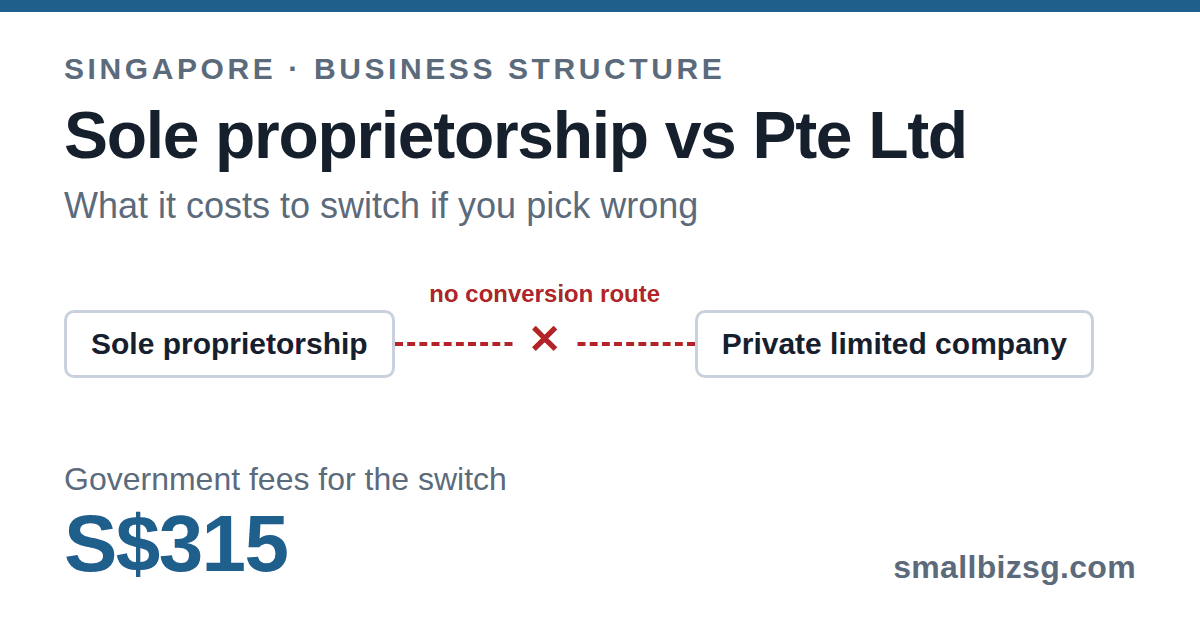
- You can’t convert a sole proprietorship into a company. To switch, you incorporate a new company first. That means registering it with the Accounting and Corporate Regulatory Authority (ACRA), the government body that registers businesses. Then you close the sole proprietorship’s registration. They are separate filings. The steps are further down.
- Switching costs S$315 in government fees, paid to ACRA: S$15 for the company’s name and S$300 to incorporate it. Any new company pays these, so you would have paid them anyway if you had chosen a company first.
- If the sole proprietorship was the mistake, its fees don’t carry over to the company. With a one-year registration they were S$115: S$15 for its name and S$100 to register it. That makes S$430 in government fees for the whole episode. Closing the sole proprietorship is free.
- Close it while the registration is still live, meaning before it expires. Once it expires, you have to renew it before you’re allowed to close it: S$30 for a year, and ACRA warns you may also face a late renewal penalty.
- Once you stop doing business as the sole proprietorship, you have 14 days to file its closing, which ACRA calls a cessation. You may have read that you have three months to close it; that deadline doesn’t exist.
The fees are the cheap part. The work that follows costs more: a company bank account, contracts moved into its name, and a fresh check of its licences.
I’d registered a sole proprietorship when what I needed was a company. The two are different things entirely: a different law, a different Unique Entity Number (UEN), and, with the sole proprietorship, my name behind its debts. The UEN is the number a registered business uses to deal with government agencies.
Nothing in the process asked whether I’d understood the choice; an accountant noticed afterwards. The explanations I found then described the two structures correctly, but only in general terms. What none of them said plainly was the thing that mattered once I’d chosen wrong: there is no undo.
- A sole proprietorship is you; a company is someone else
- Sole proprietorship vs Pte Ltd, side by side
- When a sole proprietorship is enough, and when you need a company
- How to switch from a sole proprietorship to a Pte Ltd
- What I’d tell someone about to file, or just filed
A sole proprietorship is you; a company is someone else
The difference that matters isn’t tax. It’s whether the business is a separate legal person from you.
A sole proprietorship is you. ACRA’s own description is that it is not a separate legal entity from the owner. There’s no second party.
The business doesn’t own anything — you do. It has no debts of its own either; they are yours. If it’s sued, you’re sued.
ACRA calls this unlimited liability: you are personally responsible for all of the business’s debts. If they can’t be paid, your savings and in principle your home are what stand behind them. The name is a trading name attached to a person, and the person is you.
A company is someone else. It’s a separate legal entity that can sue and be sued, and own property, in its own name. Its bank account is genuinely its own, not yours with a business label on it.
Its shareholders, who own it through their shares, have what ACRA calls limited liability: they are not personally responsible for the company’s debts. If it fails, what they put in is generally what they lose. That’s what “limited” means in “private limited company”: the limit is on how far the failure reaches into your own life.
One common exception: a bank or landlord may ask a director, a person who manages the company, to sign a personal guarantee. If you run the company alone, that director is you, and the guarantee puts your own savings and property back behind that particular debt.
Once you’ve got that, the rest stops being a list to memorise. A sole proprietor’s profits are taxed as personal income, because they are personal income. A company files its own tax return, because it’s its own taxpayer.
A company carries on until it is formally closed; a sole proprietorship lasts only while its owner is alive and chooses to continue it. Ending it still takes a filing, as the steps below show. A company is a person; a sole proprietorship is a description of what a person is doing.
I got it wrong because at the point of choosing, this distinction isn’t in front of you. You’re looking at a form asking what kind of entity you want. Both options are one click away, and only one of them, the company, changes whether your own savings and property stand behind the business’s debts.
Sole proprietorship vs Pte Ltd, side by side
Every figure below comes directly from ACRA or the Inland Revenue Authority of Singapore (IRAS), the government’s tax authority, checked on 16 October 2026. The sources are listed at the end.
| Point of comparison | Sole proprietorship | Private limited company (Pte Ltd) |
|---|---|---|
| Legal identity | Not separate from you | A separate legal entity |
| If it owes money | You owe it, personally and without limit | The company owes it; shareholders aren’t personally responsible |
| Who owns it | One owner | One to 50 shareholders |
| Tax on profits | Your personal income, at individual rates | The company’s own income, at Singapore’s corporate rate of 17% |
| Name application | S$15 | S$15 |
| Registration | S$100 for one year, or S$160 for three | S$300, once |
| Cost to keep it alive | S$30 to renew for a year, or S$90 for three | S$60 a year to file its annual return, a yearly filing to ACRA |
| Renewal | Must be renewed every one or three years or it expires | No renewal; exists until wound up or struck off (both explained below) |
| Ending it | Closing on Bizfile: free and immediate while the registration is live | Must be formally struck off or wound up |
ACRA’s own totals for setting up a sole proprietorship are S$115 with a one-year registration and S$175 with a three-year one. Both include the S$15 name fee.
A sole proprietor is self-employed, and a self-employed person must also pay into MediSave, a savings account for their own healthcare costs. That applies when their yearly net trade income, broadly the business’s profit, is above S$6,000.
MediSave is part of the Central Provident Fund (CPF), Singapore’s national savings scheme. The CPF Board, a government body, sends a notice of how much to pay.
Those payments, in full or by monthly instalments, must be up to date before a sole proprietorship’s name is reserved and before any renewal. To renew for three years, the owner must either owe no MediSave, or have paid monthly instalments for at least 24 months in a row. A first registration for three years depends on conditions the CPF Board sets, which ACRA’s registration page doesn’t list.
Bizfile is ACRA’s online portal, where you register either structure and close a sole proprietorship. A company that is inactive and has no debts is closed by being struck off: its name is removed from ACRA’s register. One with debts to settle is wound up instead, a formal process that includes settling them.
Sources: ACRA’s fee pages for companies and sole proprietorships and partnerships, its pages on registering and renewing a sole proprietorship and on closing a local company, its Choosing a business structure page, and IRAS for the tax rate.
What the table doesn’t show
The yearly gap is small on paper and misleading in practice. S$30 against S$60 looks like nothing, but a company has far more to do than a sole proprietorship.
A company must appoint a company secretary, an officer who helps it comply with the law. It must also appoint an auditor, an accountant registered with ACRA who checks its financial statements. The exception is a company that is exempt, which means the audit rule doesn’t apply to it.
A company must also keep registers unless exempt, and file an annual return. It must hold an annual general meeting (a yearly meeting of its shareholders), unless it is exempt or they all agree to skip it.
ACRA’s Choosing a business structure page lists two key ongoing requirements for a sole proprietorship: keep MediSave contributions up to date, and renew the registration. ACRA’s fee is the smallest part of what a company costs to run, which is a real argument for a sole proprietorship.
Tax isn’t the deciding factor at small numbers. At low profits, a tax resident’s personal rates can work out below the company rate of 17%.
A qualifying new company can also claim a start-up tax exemption, which means part of its profit isn’t taxed in its first three tax years. So the rate it actually pays drops as well. If tax really is your deciding factor, that’s a conversation with an accountant about your own numbers.
When a sole proprietorship is enough, and when you need a company
A sole proprietorship, when all three are true
- You’re one person, with no partner or investor
- The worst loss you could realistically face is one you could pay yourself
- You might close it within a couple of years
A company, when any one is true
- Someone could sue you for more than you could comfortably pay
- You need to bring in a partner or an investor
- Clients check who they’re signing contracts with: larger companies, agencies, anyone with a formal buying (procurement) process
- You want the business to be able to carry on without you
A weekend tutoring practice is the sole proprietorship shape, and so is a small freelance design business whose clients don’t check who they’re contracting with. Registering a company for one of those buys obligations you’ll resent and protection against a risk you don’t face.
The question worth asking before you file
Not “which is cheaper” or “which looks more professional.” Just this: if this goes wrong in the worst way you can realistically imagine, do you want the bill arriving at your house?
If the realistic worst case is more than you could pay, that points to a company. The S$300 incorporation fee is small next to that bill.
You can’t go back the other way
If you choose a company and later want a sole proprietorship instead, ACRA lists no way to turn the company into one. You register a new sole proprietorship and move the business to it. Then you close the company by striking it off, or by winding it up if it has debts to settle.
Applying to strike a company off is free. Among ACRA’s conditions, the company must have stopped trading and must own nothing and owe nothing, which is why it is closed last. ACRA then allows 60 days for objections before it removes the company’s name from its register.
How to switch from a sole proprietorship to a Pte Ltd
You do not convert. You incorporate a new company, and you close the old registration. They are separate filings, and filing one does nothing to the other.
What you actually do instead of converting
What actually happens: two separate steps
The new company
Do this first: the company’s bank account and the contracts it takes over need a company that already exists.
The old registration
Filed within 14 days of stopping, once the last work is finished or has moved to the company. Free and immediate, but only while the registration is still live.
In practice, the steps run in this order:
- Apply for the company’s name on Bizfile (S$15). If it is the same name as your sole proprietorship’s, include a letter of consent, explained below.
- Incorporate the company (S$300). Most registrations are approved soon after payment. Complex ones take up to 15 working days, and those that another agency must approve take 14 to 60 days.
- Open the company’s bank account, arrange to put your contracts in the company’s name, and check which licences the company needs.
- Stop doing business as the sole proprietorship, once its last work is finished or has moved to the company. ACRA calls that day the date of cessation.
- Apply to cancel its Goods and Services Tax (GST) registration, if it has one, and settle its remaining matters. GST is a tax that GST-registered businesses charge on their sales and collect for IRAS.
- File its closing on Bizfile within 14 days of stopping, while the registration is still live.
Nothing is updated for you. If you do not file the closure yourself, the sole proprietorship’s registration carries on, still in your name, with its renewal date still running.
ACRA’s fee pages and guides list conversions, such as from one type of company to another. None of them turns a sole proprietorship into a company.
Setting up the company costs S$315 in government fees, a total ACRA prints on its Choosing a business structure page, and the closure is free. The S$15 name fee isn’t refunded if the name is rejected or you withdraw it, and a new application means paying it again.
The S$315 leaves out what you might pay a corporate service provider (a firm that can register the company for you) or an accountant. You can also register it yourself on Bizfile, if you reserved its name and will be either one of its directors or its secretary. The S$315 also doesn’t include the running costs that start the moment the company exists.
Sources: ACRA’s Choosing a business structure, its fee page for companies, and its guides to applying for a business name, registering a local company, what to do after registering it and closing a sole proprietorship or partnership. The registration that carries on and the 14 days: sections 14 and 22 of the Business Names Registration Act 2014.
The order matters more than the paperwork
The company comes first and the closure second, and that order is a practical necessity rather than a rule. A bank can open the company’s account only once the company exists, because the account is the company’s, not yours. ACRA’s after-registration guide says it can be opened immediately after registration.
Contracts cannot move to an entity that does not exist yet either. When you open the account, ask your bank first which route it expects: printed documents, scanned copies or an online application.
One thing about the name catches people out. If the company will share your sole proprietorship’s name, ACRA’s name guide asks for a letter of consent from that business’s owner. That owner is you.
So you’re writing a letter to ACRA giving yourself permission to use your own business name. It’s easy to overlook, but ACRA lists it among the documents to prepare, so have it ready before you apply. An approved name is reserved for 120 days: register the company within that time, or the name is released for others to use.
What doesn’t come with you
The new company is a different legal person, so none of the following moves across by itself.
- GST registration, if the sole proprietorship has one. It is the sole proprietor’s. IRAS says you must apply to cancel it within 30 days when the business has stopped. The same applies when the business changes form, for example from a sole proprietorship to a private limited company. The company then works out whether it must register in its own right.
- The UEN. The company is issued its own Unique Entity Number when it is registered.
- The bank account. The company opens its own. The sole proprietorship’s account is yours, not the company’s.
- Contracts. Agreements signed in your name are yours, not the company’s. Talk early to the other parties, such as a landlord or clients, about putting them in the company’s name.
- Licences and permits. ACRA’s after-registration guide tells a new company to check which licences and permits it needs before it starts operating. Don’t assume the sole proprietorship’s licences cover it.
Before you file the closing, ACRA’s closing guide tells you to make sure any GST registration has been cancelled and administrative matters are settled. Its examples: completing any ongoing contractual obligations, transferring vehicle ownership, and resolving any loans or grants still linked to the business.
The guide describes the date of cessation as the date the business “ceased its business or operations”. So the 14 days start when its last work is finished or has moved to the company, not when it stops taking new work.
IRAS approves most online GST cancellations on the day you apply, though some take 1 to 10 working days. So apply as soon as you stop: the closing is due within 14 days of stopping.
Each of these is a separate job, and together they are why people call the switch painful even though the government fee is only S$315.
Close it while the registration is still live
Closing a sole proprietorship is free and takes effect as soon as you file — while the registration is still live. ACRA’s own page is explicit about what happens if it isn’t:
If your business registration has expired, you need to renew it before you can close the business.
So the cost of closing depends entirely on when you do it.
What closing takes depends on when you do it
The closing filing itself is free. What changes is what has to happen first.
ACRA sends a renewal reminder 60 days before expiry, and says registration may be cancelled 60 days after the expiry date. Running the business after expiry is an offence. ACRA closing and renewal pages; Business Names Registration Act 2014, sections 14 and 24. Checked 16 October 2026.
After expiry you renew first, at S$30 for a year, and then close. The renewal needs the owner’s MediSave contributions paid or on an instalment plan, as above.
A late renewal may bring a penalty: ACRA’s renewal page says you “may face late renewal penalties”, without saying when ACRA charges one. If ACRA charges one, its page on the Business Names Registration Act gives the amount: S$50 up to three months late, and S$200 after that.
Letting the registration expire is not a way of closing it: until ACRA cancels it, an expired registration still counts as registered. So a business that stops in that time must renew and then file its closing within 14 days of stopping, not wait for a cancellation. ACRA also says plainly: “It is an offence to run your business after your registration expires.”
If ACRA does cancel the registration, which it may do 60 days after the expiry date, the business is no longer registered. There is then no registration left to close. Restoring it is optional, only for an owner who wants it back.
You may see S$30 quoted as a deregistration fee. It is ACRA’s one-year renewal fee for a sole proprietorship, not a closure fee, though after expiry it has to be paid before closing.
Sources: ACRA’s Closing a sole proprietorship or partnership, Renewing your registration and its page on the Business Names Registration Act 2014, and sections 14, 22 and 24 of the Act.
The deadline is 14 days after you stop doing business, not three months
Section 22(1) of the Business Names Registration Act 2014 sets the deadline. A registered person who stops carrying on business under the business name must file a notice of this (the closing) within 14 days after stopping. Missing the deadline is an offence: under section 22(3), a court can fine the owner up to S$5,000.
So the clock starts when you stop doing business as the sole proprietorship, not when the company is incorporated. It runs for 14 days, not three months.
You may have read that the sole proprietorship must be closed within three months of incorporating the company. ACRA publishes no such deadline: not in its closing guide, on its renewal page or in its questions and answers on the Act. The Act sets none either.
There is a real three-month deadline, but it belongs to the new company. ACRA tells it to appoint an auditor within three months of registration, unless it is exempt from audit. Every company must also appoint a company secretary within six months.
What I’d tell someone about to file, or just filed
The registration isn’t the decision. I treated filing as the moment of commitment, but the commitment comes before it. ACRA registers what you ask for, usually soon after you pay, and asks you nothing about whether it suits you. The thinking has to happen before the form, and the test earlier in this post is a place to start.
If you’ve already filed and think it was wrong, look at it now rather than later. Incorporate the company first, then close the sole proprietorship while its registration is still live. Once it expires, closing means renewing first, and that cost is entirely avoidable.
What the whole switch cost me beyond the fees, I can’t tell you. I didn’t keep a running total in 2024, and I’m not going to reconstruct one from memory and present it as a figure.
What I can say is which part was expensive, and it wasn’t the S$315. It was the second round of everything: a second set of decisions, a second name approval, a second application, and the stretch in between when the business was not really either thing.
Where these facts came from
Every fee, deadline and quotation in this post was read on 16 October 2026, on the pages of ACRA, IRAS, the CPF Board and Singapore Statutes Online. Singapore Statutes Online is the Attorney-General’s Chambers’ website for Singapore’s laws. Where a page prints its own date, the oldest is 18 August 2025 and the newest 16 October 2026.
ACRA prints the S$315, S$115 and S$175 totals on its Choosing a business structure page; the S$430 is this post’s own sum.
| What | Pages |
|---|---|
| The two structures: a sole proprietorship has one owner, is not a separate legal entity, its owner has unlimited liability, and it continues while the owner is alive and chooses to continue it; a private company has one to 50 shareholders, who own it through their shares, with limited liability, and directors who manage it; a company is closed only by striking off (its name removed from the register) if inactive and debt-free, or winding up if there are debts; striking off is free to apply for, needs among other conditions a company that has stopped trading and owns and owes nothing, and allows 60 days for objections; ACRA, the national regulator of business registration; IRAS, the tax authority | ACRA — Choosing a business structure, Closing a local company, Striking off a local company, Overview of ACRA; IRAS — History and milestones |
| Company fees: S$15 name application, S$300 incorporation and its processing times (most soon after payment, up to 15 working days, or 14 to 60 days where another agency must approve), the S$315 total, S$60 annual return; who may register a company (the person who reserved the name, appointed a director or secretary); the company’s own UEN, used to deal with government agencies | ACRA — Service and transaction fees: companies, Registering a local company via Bizfile, Choosing a business structure |
| Sole proprietorship fees: S$100 for one year or S$160 for three, the S$115 and S$175 totals, S$30 and S$90 renewals; MediSave, a self-employed person’s healthcare savings, required above S$6,000 of yearly net trade income (gross trade income less allowable business expenses, capital allowances and trade losses, as IRAS determines them) and up to date before a name is reserved and before any renewal; the CPF, a national savings scheme, and the CPF Board, a statutory board that sends the notice of the MediSave to pay; the three-year rates’ conditions (the CPF Board’s for registration; for renewal, no MediSave owing or at least 24 months of monthly instalments); the two key ongoing requirements | ACRA — Service and transaction fees: sole proprietorships and partnerships, Registering a sole proprietorship or partnership, Renewing your registration, Overview of managing a sole proprietorship or partnership, Choosing a business structure; CPF Board — Saving under the Self-Employed Scheme, Who we are |
| The name: the S$15 fee is non-refundable; an approved name is reserved for 120 days, then released; a letter of consent for an identical name | ACRA — Applying for a new business entity name |
| Closing: free and immediate; the date of cessation; GST cancelled and administrative matters settled first; renewal before closing an expired registration; the offence of trading after expiry, the 60-day reminder, cancellation 60 days after expiry, and the penalty ACRA may charge for renewing late, S$50 up to three months late and S$200 after | ACRA — Closing a sole proprietorship or partnership, Renewing your registration, Business Names Registration Act 2014 |
| After cancellation: a registration stays registered after expiry unless cancelled, and cancellation ends it; restoring it is optional; sections 14 and 24 | Singapore Statutes Online — Business Names Registration Act 2014, Part 2 |
| No conversion: the conversions ACRA’s guides and fee pages list, such as from one company type to another, none between a sole proprietorship and a company, either way | ACRA — Applying for a new business entity name, Service and transaction fees: companies, Service and transaction fees: sole proprietorships and partnerships |
| The 14 days: notice of cessation within 14 days after stopping business, section 22(1), where business includes any activity carried on for gain, section 2(1), and a court fine of up to S$5,000 for missing it, section 22(3); no three-month deadline in the Act or in ACRA’s FAQs on it | Singapore Statutes Online — Business Names Registration Act 2014, Part 2; ACRA — Business Names Registration Act 2014 |
| The new company: a company secretary within six months and an auditor within three months of registration, unless exempt from audit; an auditor, an accountant registered with ACRA; an annual general meeting unless exempt or dispensed with; its bank account and licences after registration | ACRA — Post-registration guide: local company, Due dates and requirements for annual general meetings, Audit regulation in Singapore |
| GST: a tax GST-registered businesses charge on their sales and collect for IRAS; an application to cancel the sole proprietorship’s registration within 30 days when the business has ceased or its form has changed, as from a sole proprietorship to a company, the registration being in the owner’s own name; most online cancellations approved the same day, some in 1 to 10 working days; the company works out whether it must register | IRAS — GST: What it is and how it works, Cancelling GST registration, Do I need to register for GST |
| Tax: Singapore’s 17% corporate rate and the start-up tax exemption; a tax resident’s personal rates rise with income, so at low profits they can work out below 17% | IRAS — Corporate income tax rate, rebates and tax exemption schemes, Individual income tax rates |
Fees and rules change. If something here has gone out of date, tell me and I will correct it and note when it was corrected. If you’re about to file, start with ACRA’s Choosing a business structure page, then the ACRA guides above for the structure you choose.
What this post is not
I’m not a lawyer, an accountant or a corporate service provider, and nothing here is advice about your situation. It’s what the rules say, where the figures came from, and what happened in one case — mine. If anything about your circumstances is unusual, an hour with someone qualified costs less than doing the whole thing twice.
It doesn’t cover partnerships of any kind, foreign owners, what a company has to file every year, or how to work out the tax under either structure.
This post was drafted with AI assistance and fact-checked against the sources above before publishing. See the Disclosure page for how this site is paid for and what it will not take money for.